
Asset Sale VS. Stock Sale California Taxes: A Planning Guide
Asset vs Stock Sale: California Tax Planning Guide
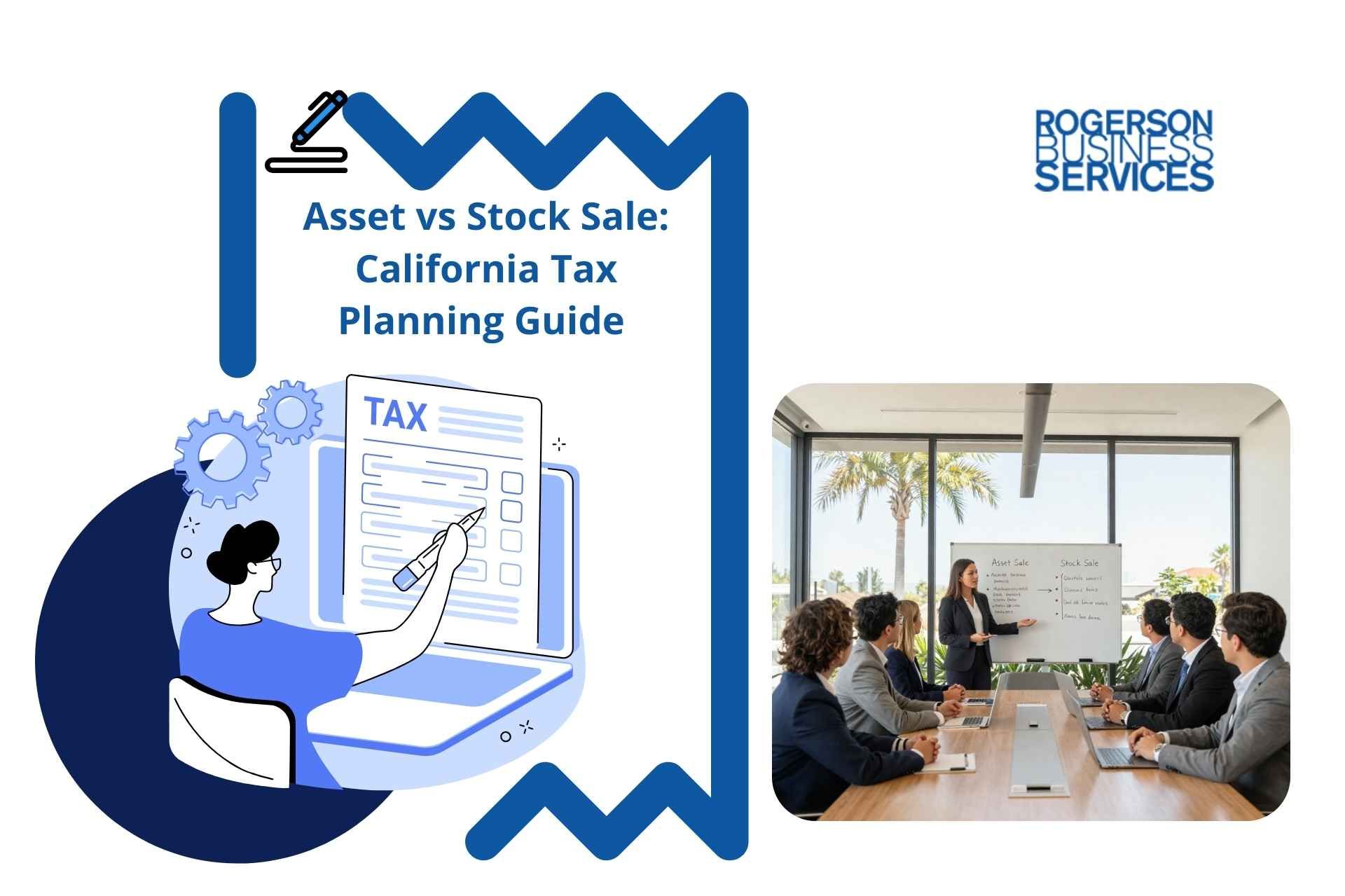
If you plan to sell a California business, you’ll hear the same push-pull early: buyers often push for an asset deal, but sellers often push for an equity deal (a stock sale, or the sale of LLC interests). The structure can change your after-tax proceeds even when the headline price stays the same.
So which structure minimizes California taxes?
Here’s the honest answer: California usually taxes your gain either way if you sell as a California resident, so the “best” structure depends less on a special California capital gains rate and more on (1) your entity type, (2) how you allocate price in an asset deal, (3) whether the deal includes rollover equity or an earnout, and (4) when you start planning—ideally before the LOI.
Key Takeaway: Treat deal structure like a net-proceeds project, not a legal formality. Model taxes early, negotiate the tax drivers in the LOI, and then document them in the purchase agreement.
Asset sale vs stock sale California taxes: the decision drivers

When you ask which structure minimizes California taxes, you really ask which structure protects your net proceeds after you model federal character, California residency exposure, and the deal terms that can turn sale proceeds into ordinary income.
Asset sale vs equity sale in California: quick comparison for California sellers
Use this matrix as your first pass, and then work through the criteria sections below.
| Evaluation criterion (seller view) | Asset sale (typical) | Equity sale: stock sale or LLC interest sale (typical) |
|---|---|---|
| Federal tax character | Often mixed: some capital gain, some ordinary income, because allocation can trigger recapture and ordinary items | Often cleaner: gain on equity can qualify as capital gain (facts and entity type matter) |
| California state tax impact | California taxes the gain at ordinary income rates; ordinary vs capital character still matters for federal, and it can matter for certain items | California taxes the gain at ordinary income rates; structure still matters for federal character and special situations |
| Purchase price allocation | Central: you and buyer must allocate among assets (Form 8594 / §1060); this can shift tax character | Not an asset-by-asset allocation in the same way (although elections can change this) |
| Earnouts / contingent payments | Can work, but you must watch characterization and timing | Can work, but you must watch characterization and timing |
| Rollover equity | Less common in pure asset deals, but possible in certain structures | Common in PE-style deals; can defer some tax if structured correctly |
| Liability “cleanliness” | Often cleaner for the buyer (they pick assets and liabilities), so buyers may pay less “risk premium” | Buyer inherits the company’s history, so they push harder on reps, warranties, and indemnities |
| Operational friction | More transfers (contracts, permits, leases), so it can take longer | Often simpler legally, but diligence and indemnity negotiations can intensify |
If you want a deeper overview of structure trade-offs beyond tax, read Rogerson Business Services’ guide on asset sale vs stock sale.
1) Start with the driver that controls everything: your entity type
Before you compare an asset sale and an equity sale, identify how you operate today:
- C corporation
- S corporation
- LLC taxed as a partnership
- LLC taxed as an S corporation
- Sole proprietorship
That choice changes what “asset sale” and “equity sale” even mean for taxes, and it can change whether you face one layer of tax or two layers of tax. The IRS keeps a seller-friendly overview of how selling a business can create different types of gain in its Sale of a business guidance.
Why this matters in California
California doesn’t give you a special state long-term capital gains rate, so a big gain can still create a meaningful California tax bill regardless of structure. However, you still need to manage federal character (capital gain vs ordinary income) because federal tax often drives most of the delta in net proceeds.
2) Compare federal vs California tax impact by structure
Federal: Why sellers often prefer equity sales
In many middle-market deals, sellers prefer equity sales because they often treat most of the gain as a capital gain at the owner level. The IRS explains the basic capital gain concept in Topic no. 409 (Capital gains and losses).
By contrast, an asset sale often creates mixed tax character because you don’t sell “the business” as one item. Instead, you sell a set of assets, and each asset has its own tax rules.
California: why “minimizes California taxes” often turns into “minimizes unpleasant surprises”
Because California taxes capital gains like ordinary income, the structure question usually becomes:
- How much of the deal becomes ordinary income federally?
- When do you recognize that income (closing vs later)?
- Do residency and sourcing rules pull California into the result?
If you changed residency recently, or if you expect earnout payments after a move, bring your California CPA in early. The Franchise Tax Board explains the framework for nonresidents and residency changes in Taxation of Nonresidents and Individuals Who Change Residency (FTB).
Many owners search for “California capital gains tax business sale” because they want a quick rate answer, but structure and character usually move more dollars than a single rate discussion.
⚠️ Warning: Do not “wait to see what structure the buyer offers.” Once you sign an LOI and enter exclusivity, you lose leverage to change structure, and you may also lose time to execute pre-close planning.
3) Purchase price allocation: the asset-sale lever that changes your net proceeds
If you sell via an asset sale, you and the buyer must allocate the purchase price among asset classes. That allocation can shift how much of your proceeds get taxed as ordinary income versus capital gain.
The IRS requires both parties to report the allocation in Form 8594 (Asset Acquisition Statement), and the IRS instructions describe the residual method in the Instructions for Form 8594.
Use this lens when you negotiate an asset deal: purchase price allocation Form 8594 drives what portion of your proceeds lands in ordinary-income buckets versus capital-gain buckets.
How allocation typically changes seller taxes
Allocation can increase your taxes when you push too much price into ordinary-income buckets, such as:
- inventory
- accounts receivable
- certain depreciable assets that can trigger depreciation recapture
Allocation can improve your seller-side result when you support a reasonable allocation to goodwill and going concern value, because that category often receives capital gain treatment for sellers.
What to negotiate (and document)
Negotiate and document these points, because they control whether you can defend the allocation later:
- a process and timeline to agree on allocation
- appraisal expectations for real estate, equipment, and intangibles
- how post-close adjustments (including earnouts) will update Form 8594
If you want to understand how structure choices fit into the broader sale process, see the Rogerson guide on deal structure.
4) Rollover equity: defer tax only if you structure it correctly
Rollover equity means you take part of your proceeds in equity of the buyer or the post-close company, and you “roll” value forward rather than cashing out 100% at closing.
Owners like rollover equity because it can align incentives and create a second bite at the apple, but it can also create tax risk if the documents turn “equity” into disguised compensation.
How rollover equity affects taxes (high level)
At a high level, rollover equity can defer some gain if the transaction qualifies for nonrecognition treatment, but the details matter. In corporate and partnership structures, contingent or performance-based equity can also trigger ordinary income treatment if it ties too closely to services.
RSM flags that risk in its discussion of contingent equity and earnouts, especially when the documents tie the payout to employment or services, in Tax considerations for contingent equity in M&A transactions (RSM).
Use this rollover equity checklist
Ask these questions before you agree to the terms:
Keep one phrase in your working file as you negotiate: rollover equity tax treatment depends on how the documents tie your equity to services, vesting, and the type of consideration.
- Will the rollover equity vest because you keep working, or because the business hits performance targets?
- Does the deal document say “purchase price,” or does it say “compensation,” “bonus,” or “incentive”?
- Can you transfer the equity, and will you receive standard owner rights?
- Will the buyer issue equity at closing, or later, and why?
If you can’t answer these clearly, pause, and bring your M&A tax advisor into the drafting process.
5) Earnouts: protect capital-gain treatment and manage timing
Earnouts can bridge valuation gaps, but they can also produce unpleasant tax outcomes if you structure them poorly.
Two earnout paths that create very different tax outcomes
Earnout language often pushes you into one of two lanes:
- Purchase price earnout: You receive additional sale proceeds if the business hits targets.
- Compensation-like earnout: you receive payments because you keep working, you hit individual KPIs, or you provide post-close services.
In practice, earnout tax treatment installment sale questions come down to whether the documents treat the earnout as a true deferred purchase price or as compensation.
The second lane can trigger ordinary income treatment, so you should treat earnout drafting as a tax project, not a boilerplate clause. RSM describes the services-link risk in its contingent equity guidance.
Practical ways to reduce earnout tax ambiguity
- Tie earnout metrics to business performance, not to your personal services.
- Keep employment compensation at market, and separate it cleanly from deal consideration.
- Define measurement periods, accounting methods, disputes, and audit rights.
- Model the earnout as “maybe” money, and then pressure-test your cash flow for estimated taxes.
6) Deemed asset sale elections: a common “hybrid” solution
Sometimes a buyer wants an equity deal legally (for permits, contracts, and continuity), but they want asset-sale tax benefits. In some situations, the parties can use a deemed-asset election, such as a Section 338(h)(10) election or a Section 336(e) election.
In plain English: you sell equity, but the tax law treats the transaction like an asset sale under specific rules.
When you compare structures, add one more row to your model: 338(h)(10) election vs asset sale often becomes the real negotiation when the buyer wants a basis step-up, but you want stock-sale form.
These elections can help the buyer because they can create a step-up in asset basis, but they can also change the seller-side tax result. So you should evaluate them early, and you should negotiate economics accordingly.
7) Timing: Start tax planning before the LOI, not after
Owners often wait for the LOI because they want “real numbers” before they spend money on advisors. However, that timing can backfire because the LOI often locks structure, price mechanics, and exclusivity.
Use this timeline to stay ahead.
Before LOI: run the net-after-tax model and pick your non-negotiables
Do these actions before you sign:
- Identify your entity type and ownership structure.
- Estimate the tax character mix under both structures.
- Flag assets that can trigger ordinary income or recapture.
- Decide where you will push, but also decide where you can trade.
- Align your team, because tax, legal, and M&A terms connect.
If you want a seller-focused LOI walkthrough, see LOI negotiation tips.
Between LOI and signing: translate tax goals into contract language
- Define or commit to a purchase price allocation process.
- Draft earnout terms so they match the intended tax treatment.
- Draft rollover equity terms so they match the intended tax treatment.
- Decide whether any elections make sense, and document responsibilities.
Before closing: operationalize reporting and cash planning
- Finalize allocation schedules and supporting appraisals.
- Confirm how post-close adjustments update reporting.
- Model estimated taxes and confirm cash availability.
- Plan for your filing package so your CPA can file consistently.
8) Net-after-tax worksheet: compare asset vs equity sale on one page
Worked example (illustrative): S-corp seller, $10M price, California resident at close
The worksheet above is intentionally blank so your CPA can plug in your actual numbers. But here’s a simplified example to show where the structure differences usually come from.
Scenario assumptions (illustrative only):
- Seller is a California resident individual and owns 100% of an S corporation.
- Purchase price is $10,000,000, all cash at closing.
- No earnout, no rollover equity, no non-compete payment (those can change character).
- This is a high-level character/timing example; your CPA will apply actual rates, basis, and entity details.
Asset sale allocation assumption (illustrative “Option C”):
- 60% goodwill / going concern ($6,000,000)
- 25% equipment potentially subject to depreciation recapture ($2,500,000)
- 15% inventory + accounts receivable taxed as ordinary income ($1,500,000)
How the tax character often differs (conceptual):
- Asset sale (common seller outcome):
- Ordinary income often includes inventory/AR and recapture items.
- Capital gain often includes goodwill/going concern (facts matter).
- Both parties must report allocation on Form 8594 / §1060.
- Equity sale (common seller outcome):
- Seller’s gain on stock is often capital gain (subject to basis/holding period and other facts).
- You generally avoid an asset-by-asset allocation fight (unless a deemed-asset election applies).
California note: California generally taxes capital gains at the same rate as ordinary income for individuals, so in this simplified illustration, the big swing is usually federal character (ordinary vs capital) and timing, not a special CA capital gains rate.
Important: This example is for education only and isn’t a calculation of your taxes. Ask your CPA to build a version that includes your basis, historical depreciation schedules, NIIT exposure, and any deal terms (employment, consulting, non-compete, earnouts) that can re-characterize proceeds.
Use this worksheet to compare outcomes. Your CPA can refine the tax lines, but you can start with a simple model and spot the levers that matter.
| Line item | Asset sale estimate | Equity sale estimate | Notes/assumptions |
|---|---|---|---|
| Gross purchase price | Headline price (before working capital, debt, fees) | ||
| Less: debt paid off at close | Buyer often requires payoff | ||
| Less: working capital adjustment | Target vs actual at close | ||
| Less: transaction fees | Banker/advisor, legal, accounting | ||
| Net proceeds before tax | |||
| Ordinary-income portion (federal) | Inventory, receivables, recapture, non-compete, comp-like earnout | ||
| Capital-gain portion (federal) | Often goodwill and equity gain | ||
| Federal tax estimate | Use your CPA’s rates and assumptions | ||
| California tax estimate | CA taxes gains at ordinary income rates for individuals | ||
| Net Investment Income Tax (if applicable) | Confirm with your tax advisor | ||
| Net-after-tax proceeds | |||
| Earnout value (expected) | Separate base case and downside case | ||
| Earnout tax reserve | Reserve cash for estimated taxes | ||
| Rollover equity value | Note deferral assumptions and holding period | ||
| Total value (cash + expected earnout + rollover) |
Pro Tip: If a buyer proposes an asset sale “because it’s standard,” ask them to show how much they value the basis step-up. Then negotiate price or other terms to share that value.
9) Who should choose which structure? Use these rules of thumb
Real-world California vignettes (anonymized): why planning details matter
These examples are summarized from Rogerson Business Services’ published case studies to illustrate how deal outcomes often hinge on planning details.
- Financials and valuation credibility can make or break the sale: In one Northern California roofing business sale process, strong buyer interest didn’t convert to a closing when diligence uncovered financial statement issues that eroded buyer trust (see RBS case study on why a Northern California roofing business failed to sell). Takeaway: before you negotiate the structure, make sure your reporting package is defensible—because structure and tax planning only help if the deal closes.
- Process complexity and timing can change leverage: A Bay Area moving and storage transaction ultimately closed successfully after a prior attempt nearly fell apart (seeRBS case study on selling a moving and storage business in 6 months). Takeaway: start modeling structure and tax early (pre-LOI), so you’re not trying to fix allocation, timing, or characterization issues when the schedule is tight.
If you’d like, we can add 1–2 additional vignettes (IT services, manufacturing, medical practice) and explicitly tie each to a tax lever (allocation, earnout language, or elections).
You can’t pick a structure alone because the buyer has a vote, but you can negotiate more effectively when you know your “why.”
An equity sale often fits you best if…
- You operate a business where an asset sale would force a lot of consents and transfers.
- You want a simpler seller-side tax character, and you can support it.
- You want to reduce allocation fights and focus on price and risk terms.
An asset sale often fits you best if…
- The business has liability exposure that the buyer won’t accept in an equity deal.
- The company has contracts or permits that transfer cleanly, or you can secure consents.
- You can negotiate an allocation and purchase price that protects your net proceeds.
Either structure can work if you do this one thing
Start planning before LOI.
When you negotiate structure early, you protect your net proceeds, and you also avoid last-minute surprises that can derail a deal.
Glossary (quick definitions)
- Residual method (§1060) / Form 8594: The required method for allocating purchase price among asset classes in many asset acquisitions.
- Goodwill / going concern value: Intangible value beyond identifiable assets; often a key driver of seller-favourable capital-gain character in asset deals (facts matter).
- Depreciation recapture: Rules that can re-characterize some gain on depreciated assets as ordinary income.
- Earnout / contingent payment: Additional consideration paid later if targets are met; drafting affects whether it is treated as purchase price vs compensation.
- Deemed asset sale election (e.g., 338(h)(10), 336(e)): A legal equity sale that is treated as an asset sale for tax under specific rules; can change seller tax outcomes and buyer basis.
Next steps: build a California deal tax team early
A California business sale touches federal tax, California tax, and purchase agreement drafting—so you should coordinate a team that can model the after-tax outcome and then document it.
If you want a quarterback for that coordination, Rogerson Business Services often helps owners organize the process alongside a California M&A tax team, and we keep the work confidential and owner-focused.
- Learn the broader process in Steps to sell a business in California.
- Review how valuation assumptions connect to net proceeds in the business valuation guide.
- If you’re comparing advisor support models, review therole of M&A advisors in California.
By: Rogerson Business Services (California lower middle-market M&A advisory)
About the author/firm: Rogerson Business Services advises owners of $2M–$50M revenue businesses in California on valuation, sell-side M&A execution, and exit planning.
Profiles: CABB · IBBA · M&A Source · Axial · About
Last updated: May 2026
Technical review: Ed Cotney (see team bio: https://www.midmarketbusinesses.com/about/deal-team), reviewed May 2026.
Transparency: Rogerson Business Services provides M&A advisory and valuation services; if you contact us, we may discuss engagement options. This article is educational and not personalized advice.
Privacy: If you contact us through this page, we handle your information per our Privacy Policy.
Disclaimer: This article is for educational purposes only and is not financial, tax, or legal advice. Consult qualified professionals for advice specific to your situation.
About the Author
Andrew Rogerson is an M&A advisor with 20+ years of mergers and acquisitions experience working with owner-led businesses. His qualifications include Certified Mergers & Acquisitions Professional (CM&AP) and Mergers & Acquisitions Master Intermediary (M&AMI) designations from M&A Source, a Certificate in Private Capital Markets (CIPCM) from Pepperdine University, and the Certified Business Intermediary (CBI) credential.
M&A Learning Source


Hey there! Can we send you a gift?
We just wanted to say hi and thanks for stopping by our little corner of the web. :) we'd love to offer you a cup of coffee/tea, but, alas, this is the Internet.
However, we think you'll love our email newsletter about building value and properly position your company before transition/exit your business ownership.
As a special welcome gift for subscribing, you'll also get our helping and educational guides, tips, tutorials, etc.. for free.
It's filled with the best practices for retiring serial business owners like Dan Gilbert, Larry Ellison, Warren Buffett, and many more.
Just sign up for our emails below.