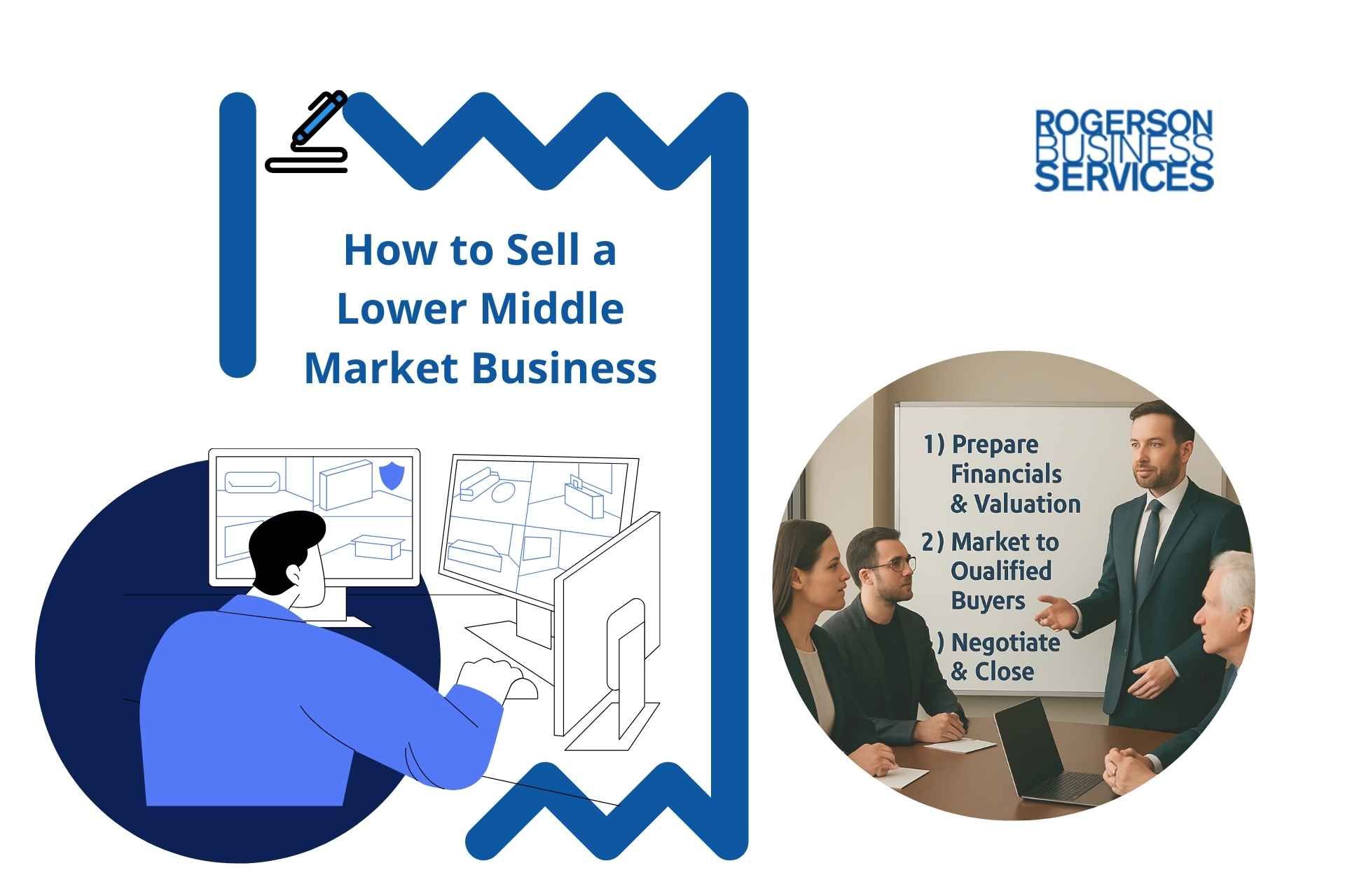
How to Sell a Lower Middle Market Business in California
How to Sell a Lower Middle Market Business
Don't have time to read more?
Take a shortcut and play the video overview below
By: Rogerson Business Services (California lower middle-market M&A advisory)
About the author/firm: Rogerson Business Services advises owners of $2M–$50M revenue businesses in California on valuation, sell-side M&A execution, and exit planning.
Profiles: CABB · IBBA · M&A Source · Axial · About
Last updated: April 2026
Privacy: If you contact us through this page, we handle your information per our Privacy Policy.
Important (general information only): This article is not legal, tax, or financial advice. M&A outcomes depend on facts and market conditions. Talk with your CPA and M&A attorney about your specific situation.
Selling a lower-middle-market business in California is less about “finding a buyer” and more about controlling risk.
The highest-leverage work happens before you go to market:
- clean financials,
- defensible add-backs,
- transferable contracts,
- and a diligence-ready story.
This guide walks you through the sell-side process from preparation to closing, with California compliance hygiene, the documents buyers actually ask for, and the decisions that most often change valuation and deal certainty.
Executive summary: The California Exit Landscape
Mini case studies (California sellers)
To show what typically moves value and deal certainty in California, here are three anonymized patterns from recent transactions:
- Landscaping & tree services (~$1.6M revenue; stock sale + separate real estate sale): Closing was delayed by SBA underwriting timing and logistics (including license and vehicle-title cleanups). Takeaway: if your buyer is using SBA financing or you’re selling real estate alongside the operating company, build extra time for appraisals/third-party reviews and fix transfer paperwork early.
- Moving & storage services (customer concentration risk >15% of revenue): An initial sale attempt failed due to concentration concerns. A later process succeeded after addressing lender/buyer concerns with stronger documentation and a clear mitigation story. Takeaway: concentration rarely “kills” a deal if you quantify the risk, show contract realities, and prepare a credible plan.
- Portable sink manufacturer (multi-million revenue; working capital adjustment in negotiations): A clean, organized diligence package and clear working-capital mechanics helped maintain momentum through escrow. Takeaway: many price disputes are really working capital disputes—set expectations early and support the numbers.
(Full write-ups: Landscaping case study, Moving & storage case study, Portable sink manufacturer case study.)
California is a large, diverse lower middle market with sophisticated buyers, tighter diligence standards, and plenty of deal friction: labor rules, licensing, local taxes, and documentation gaps that often don’t matter—until a buyer’s diligence team starts asking questions.
If you’re within a 6–24-month exit window, your job is to reduce two things:
- Earnings uncertainty (what is the “real” EBITDA after normalization?)
- Transfer risk (what could delay closing, change terms, or collapse the deal?)
You can often improve both without changing the core business. But you can’t do it in the last three weeks.
How to Sell a Lower Middle Market Business in California: A Decision-Ready Timeline
If you want the simplest way to keep momentum, think in phases. This selling a business in California timeline is typical for lower middle market deals, but every transaction stretches or compresses based on readiness, buyer financing, and complexity.
- Phase 1: Pre-sale readiness (often 4–12+ weeks) — normalize earnings, prepare diligence materials, fix preventable issues.
- Phase 2: Go-to-market (often 4–10 weeks) — teaser, buyer outreach, management calls.
- Phase 3: LOI to close (often 8–14+ weeks) — diligence, definitive documents, financing, consents, closing.
Key Takeaway: Your timeline is mostly a reflection of documentation and clarity. The more you can verify up front, the fewer “surprises” become renegotiations.
Step 1: Pre-Sale Readiness—Moving Beyond The Balance Sheet
Before you talk to buyers, run a pre-sale audit that answers one question: If a skeptical buyer tried to break this deal, where would they start?
What buyers ask for during diligence
Most buyer diligence requests cluster into predictable buckets: financial, legal, operational, and people. A practical starting checklist is Nolo’s seller-side due diligence guide, which outlines common document categories and risk-control basics like NDAs and organized data rooms.
Focus first on what tends to slow deals:
- Clean, consistent financials (and support for adjustments)
- Signed customer and vendor contracts (and clear renewal/assignment terms)
- A realistic working capital picture (not just EBITDA)
- IP ownership and key employee dependencies
- Any regulatory, licensing, or environmental exposures
Financial clean-up: EBITDA normalization that holds up in diligence
EBITDA (Earnings Before Interest, Taxes, Depreciation, and Amortization) is a common proxy for operating performance. Normalized EBITDA adjusts reported results for items that aren’t expected to recur under new ownership.
This matters because valuation in the lower middle market often starts with a multiple applied to a normalized earnings base—so a small, well-supported change can materially affect enterprise value.
Common categories of adjustments (always fact-specific):
- One-time legal or consulting expenses
- Owner compensation normalization
- Non-recurring repairs or unusual vendor spend
- Personal or discretionary expenses run through the business (where appropriate)
For a plain-English explanation and examples, see our guide to Normalized Net Income when selling a business in California.
California compliance hygiene checklist (high level)
California doesn’t create your deal structure, but it does shape closing logistics and post-close cleanup.
At a minimum, you should plan for:
- State and local account closeouts and updates (seller’s permit, payroll, local business licenses)
- Entity filings (depending on the structure and what changes hands)
- Clear documentation of ownership transfer steps for your records
California’s Office of the Small Business Advocate publishes an official overview in Sell or Close Your Business in California that’s useful for identifying which agencies typically need to be notified.
If your business holds a seller’s permit, the California Department of Tax and Fee Administration notes that permits are not transferable and provides closeout guidance in its Publication 74: Closing Out Your Account. (We recommend confirming details with your tax advisor because closeout steps can depend on facts.)
⚠️ Warning: Compliance steps are easy to underestimate. Build them into your closing timeline early and confirm requirements with your CPA/attorney.
Step 2: Accurate valuation in the Golden State
A California business valuation isn’t just “your multiple.” It’s the combination of earnings quality, risk, and terms.
The building blocks: enterprise value, add-backs, and working capital
A buyer’s model usually ties price to:
- Normalized EBITDA (or another earnings metric)
- A valuation multiple informed by comparable companies and transactions
- Working capital (the cash-free, debt-free mechanics that often create closing adjustments)
Define the terms you’ll hear throughout the process:
- Add-backs: Adjustments to earnings for items that are non-recurring or not part of ongoing operations.
- Working capital: Typically, current assets minus current liabilities (details vary). Many deals set a target level and true up at closing.
Multiples of earnings vs. discounted cash flow
Two common valuation frameworks:
- Multiples of earnings: The buyer applies a multiple to normalized EBITDA (or similar) based on comparable companies/transactions.
- Discounted cash flow (DCF): The buyer models future cash flows and discounts them back to present value.
In the lower middle market, multiples are common because they’re easier to benchmark. DCF shows up more when:
- Cash flows are stable and forecastable
- The buyer is underwriting a growth plan and wants to model scenarios
- There are strategic synergies (which may or may not be shared in price)
For California owners, also remember that deal structure can affect what a buyer is underwriting during diligence (and what needs to be transferable at close).
For example, many transactions are structured as asset sales (buyer selects assets/liabilities), while others are stock/membership interest sales (buyer acquires the entity). The right structure is fact-specific—confirm implications with your CPA and M&A attorney.
If you want to see how we approach valuation for owner-led California companies, start with Company Valuation Services for California Businesses and Owners.
Step 3: Marketing The Deal—The CIM And Confidentiality
Marketing a lower middle market deal is a trust exercise. You want competitive tension without operational disruption.
What a CIM is (and when it matters)
A CIM (Confidential Information Memorandum) is the document that tells your business story once a buyer is qualified and under an NDA.
A useful CIM typically includes:
- Executive summary (what you sell, who you serve, why you win)
- Customer and revenue profile (including concentration)
- Management and staffing overview (key roles and dependencies)
- Financial summary with a credible normalization bridge
- Growth opportunities (grounded, not speculative)
- Risks and mitigations (better to preempt than to hide)
A tight confidentiality checklist
- Executed NDAs for all prospective buyers
- A “blind profile” (teaser) that does not reveal identity
- Staged disclosure (teaser → CIM → data room)
- Buyer qualification before CIM release (financial capacity + intent)
For definitions of deal terms like LOI, earnouts, and working capital true-ups, our M&A concept comparison is a useful reference.
Step 4: Due diligence and negotiation strategies
After an LOI (Letter of Intent), diligence becomes a test of two things:
- Whether earnings are real and repeatable
- Whether the business can be transferred cleanly
What a Quality of Earnings report does (and doesn’t do)
A Quality of Earnings (QoE) report is a transaction-focused analysis that helps buyers and sellers understand whether reported earnings are recurring and cash-convertible. It often explains the bridge from reported EBITDA to normalized EBITDA and can reduce surprises during diligence.
A QoE is not a guarantee of price, and it won’t fix operational issues. But it can make negotiations less emotional because everyone is arguing from a shared baseline.
Common deal killers (and how sellers preempt them)
These issues show up frequently in diligence—and they’re easier to handle pre-market than under a closing deadline:
- Customer concentration with weak contracts
- Owner dependency (the business can’t run without you)
- Unclear IP ownership (contractors, trademarks, code)
- Labor and classification risks (contractors vs employees)
- Environmental or facility issues that require clarification
- Messy working capital patterns that trigger closing adjustments
Pro Tip: If you can’t fix a risk, you can often frame it—quantify it, show controls, and propose a clean term solution. Surprises kill leverage.
Step 5: The Definitive Purchase Agreement And Closing
The definitive agreement is where risk is priced and allocated. For sellers, the goal is a document that is clear, financeable, and executable—not just “favorable.”
Terms that often change net proceeds
- Working capital target and true-up mechanics
- Escrow/holdback amount and duration
- Representations and warranties scope
- Indemnity caps, baskets, and survival periods
- Non-compete and transition obligations
California business escrow and closing logistics
Many deals use an escrow-style process to coordinate funds, documents, payoff letters, and transfer steps. The practical point for sellers is to plan for closeout and update steps early—especially if you have tax accounts, payroll accounts, and local permits that must be updated or closed.
For official checklists and agency touchpoints, California owners can start with CalOSBA’s “Sell or Close Your Business in California” page (linked earlier), and for federal closeout steps, see the IRS Closing a Business Checklist.
For seller’s permit closeouts, CDTFA guidance can be nuanced; if you want to see how CDTFA describes notice and liability considerations, review CDTFA Regulation 1699 and confirm how it applies to your situation with a qualified advisor.
Key Takeaways
- Deal outcomes are shaped before you go to market: normalized earnings, diligence readiness, and risk control.
- In California, plan early for compliance hygiene so it doesn’t become a closing delay.
- A disciplined data room and a defensible normalization story reduce retrades.
- Purchase agreement terms can change net proceeds as much as the headline price.
Next Steps (For Owners Ready To Move)
If you’re within a 6–24 month exit window, a practical next step is a confidential readiness review: what a buyer will question, what can be cleaned up quickly, and what should be addressed before you sign an LOI.
Request a confidential exit readiness call
- Outcome: A prioritized list of value drivers and deal risks to address before going to market.
- Best for: Owners considering a sale in the next 6–24 months.
If you prefer to self-start, use our step-by-step guide: Steps to Sell a Business in California For Max Value.
Download: California exit readiness checklist
If you want a printable set of steps and documents to gather before you go to market, use our checklist here: Prepare to Exit My Business Ownership in California (Selling Business Checklist).
FAQ
How long does a business sale take in California?
If the business is prepared, a sale process often takes months, not weeks. A typical pattern is readiness work, marketing, LOI, 30–90 days of diligence, then closing. When documentation is weak, timelines usually expand.
What is the cost of a Quality of Earnings report?
Costs vary widely based on company complexity and the scope of work. The practical way to think about it: a QoE is an up-front diligence investment intended to reduce surprises, speed buyer underwriting, and support a defensible earnings baseline. Ask your CPA or advisor for a scoped estimate.
What does “normalized EBITDA” mean?
Normalized EBITDA is EBITDA adjusted for items that aren’t expected to recur under new ownership. The goal is to present an earnings base that a buyer can verify and underwrite.
When do I share a CIM?
Typically, after a buyer is qualified and has signed an NDA. Many sellers use staged disclosure: teaser → NDA → CIM → data room.
Why does working capital matter at closing?
Even if the price is based on EBITDA, many deals include a working capital target and a true-up after close. If working capital is below target, the purchase price may be adjusted down (or held back) depending on the agreement.
Conflict note: Dual representation can create conflicts of interest. Rogerson Business Services would only consider dual representation with clear disclosures and written consent. One-time mention: In some engagements, Rogerson Business Services (RBS Advisors) may coordinate with a client’s CPA and attorney to keep diligence, tax, and legal work aligned.
Hey there! Can we send you a gift?
We just wanted to say hi and thanks for stopping by our little corner of the web. :) we'd love to offer you a cup of coffee/tea, but, alas, this is the Internet.
However, we think you'll love our email newsletter about building value and properly position your company before transition/exit your business ownership.
As a special welcome gift for subscribing, you'll also get our helping and educational guides, tips, tutorials, etc.. for free.
It's filled with the best practices for retiring serial business owners like Dan Gilbert, Larry Ellison, Warren Buffett, and many more.
Just sign up for our emails below.