What Is the California Business Transfer Tax? A Strategic Guide for Manufacturing & Industrial Owners
California Business Transfer Tax (Manufacturers Guide)

By: Rogerson Business Services (California lower middle-market M&A advisory)
About the author/firm: Rogerson Business Services advises owners of $2M–$50M revenue businesses in California on valuation, sell-side M&A execution, and exit planning.
Profiles: CABB · IBBA · M&A Source · Axial · About
Last updated: April 2026
Privacy: If you contact us through this page, we handle your information per our Privacy Policy.
If you’re a California manufacturing or industrial owner planning an exit in the next 6–24 months, you’ve probably heard the phrase “business transfer tax.” It sounds like a single, predictable line item.
In practice, it’s usually shorthand for something messier: a bundle of taxes, successor-liability rules, and valuation impacts that can change (1) your net-after-tax proceeds, (2) how the deal is structured, and (3) how much money gets stuck in escrow.
This guide explains what “California business transfer tax” typically means in lower middle-market manufacturing deals—and how to reduce surprises before a buyer’s diligence team shows up.
Throughout this article, I’m using “California business transfer tax” the way owners and buyers usually use it in practice: as a bundle of transfer-related tax exposure, not a single statutory tax with one rate.
Key Takeaway: In California, the “transfer tax” problem is less about one tax and more about how a deal is transferred: equipment, payroll accounts, and real estate can each trigger a different set of rules that affect price, timing, and risk.
California business transfer tax: why it isn’t one line item

Owners usually aren’t wrong to worry—they’re just using the wrong label.
In a typical manufacturing exit, the California business transfer tax concern tends to be a combination of:
- Sales/use tax exposure on tangible assets (especially machinery and equipment) in an asset sale.
- Successor liability rules that can make a buyer responsible for certain unpaid taxes unless releases and clearances are handled correctly.
- Property tax reassessment risk (if the deal involves real estate or the buyer is taking over an entity that holds it).
- California income tax treatment—including the uncomfortable reality that the state taxes capital gains like ordinary income.
That’s why sophisticated buyers and experienced sellers don’t negotiate only on headline purchase price. They negotiate on net proceeds, risk allocation, and closing certainty.
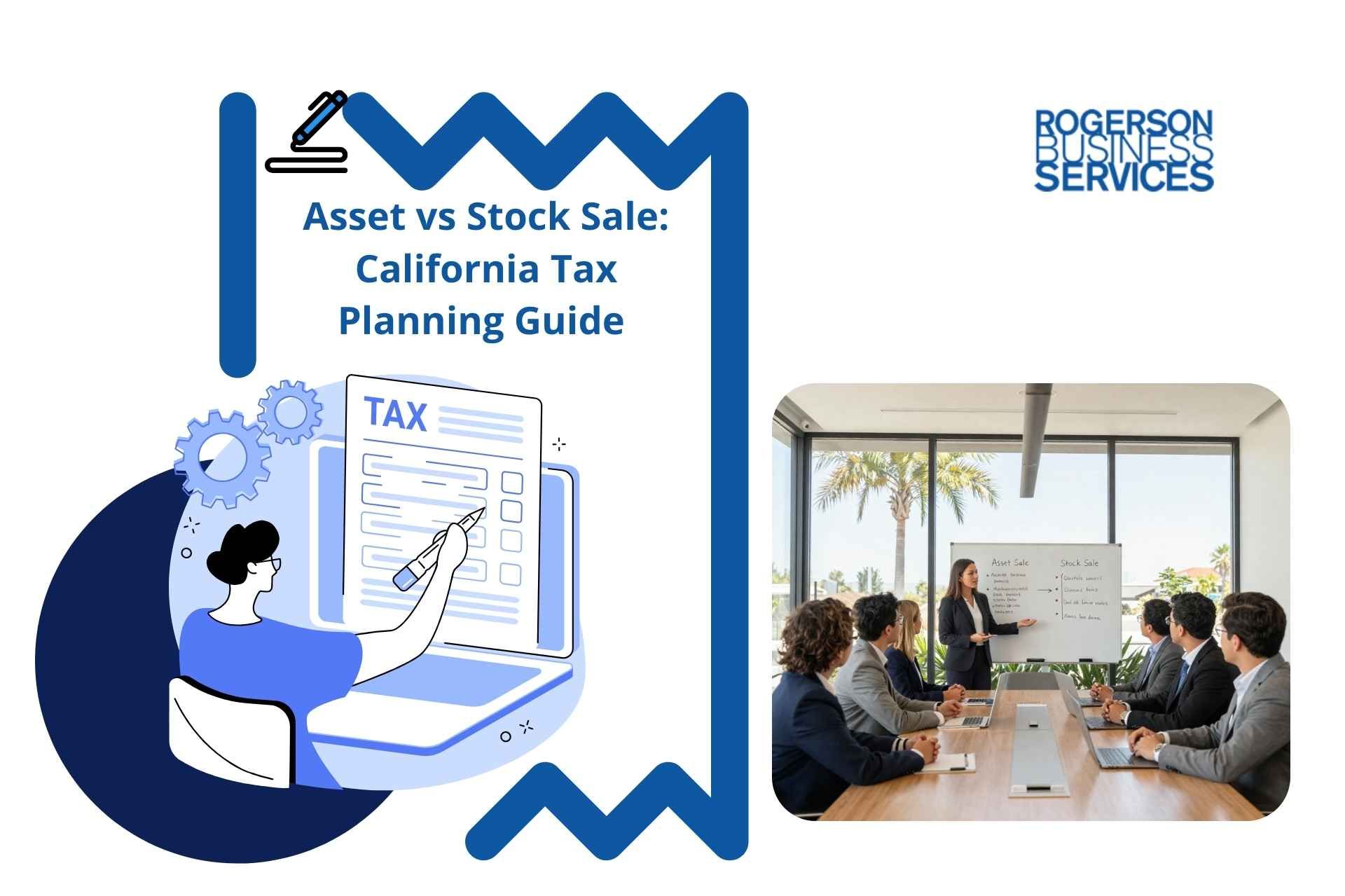
If you’re still deciding between an asset sale and a stock sale, start with Rogerson Business Services’ plain-English breakdown of asset sale vs. stock sale to understand what typically moves in each structure.
Pillar 1 — Sales and use tax exposure on equipment in an asset sale (CDTFA)
For manufacturers, the heavy equipment question is often where the “transfer tax” discussion begins.
California’s sales and use tax rules are administered by the California Department of Tax and Fee Administration (CDTFA). One of the most cited rules in business transfers is CDTFA Regulation 1595 (Occasional Sales), which explains when tax applies to sales of tangible personal property and when an “occasional sale” exemption may apply.
Why equipment can be a problem in an asset sale
In a manufacturing company, machinery and equipment are tangible personal property used in the course of a business that typically holds (or would be required to hold) a seller’s permit. In many straightforward asset sales, that puts equipment transfers in the “tax applies unless an exception applies” category.
The practical issue isn’t only the tax bill. It’s the deal friction:
- Buyers don’t want to inherit a hidden tax exposure.
- Escrow won’t want to disburse funds without clarity.
- Your “clean close” timeline can turn into an open-ended clearance process.
The two documents that matter more than your opinion
You can believe your equipment transfer should be exempt, but buyers rarely price that belief at $0.
Most buyers will insist on (a) a CDTFA clearance and (b) a well-supported allocation schedule—because in California, successor liability and documentation gaps are expensive.
CDTFA’s official guidance explains how purchasers can request a clearance through their online services.
See CDTFA’s instructions for Request a Tax and Fee Clearance. In practical terms, this is the closest thing many buyers mean when they ask for a CDTFA tax clearance certificate in a business transfer.
Purchase price allocation: where tax exposure meets negotiation
In an asset sale, the purchase price has to be allocated across buckets (inventory, equipment, goodwill, non-compete, etc.). That allocation affects both sides:
- Buyers often want more allocated to equipment so they can depreciate it.
- Sellers often prefer more allocated to goodwill (and less to equipment or ordinary-income buckets) to reduce recapture risk and simplify exposure.
There’s no one “right” allocation. But there is a right process:
- Tie equipment values to something defensible (appraisal, recent purchase records, property tax filings, realistic market comps).
- Anticipate the buyer’s depreciation goals and negotiate tradeoffs knowingly.
- Model net proceeds under multiple allocation scenarios.
⚠️ Warning: A purchase price allocation that doesn’t match your documentation trail (equipment schedules, invoices, and property filings) can invite extra scrutiny and delay.
California successor liability: why buyers push for clearance or withholding
Even when you structure a deal as an asset sale, certain California rules can still create buyer exposure.
CDTFA’s successor liability enforcement includes serving a notice within a defined timeframe. Under CDTFA Sales & Use Tax Law §6814, CDTFA’s notice of successor liability generally must be served within three years after CDTFA is notified of the purchase.
This is one reason buyers don’t like ambiguity. If they don’t have clear releases or a clearance certificate, they may respond by:
- insisting on a larger escrow holdback,
- widening indemnities (or refusing caps), or
- slowing the process until they feel protected.
Pillar 2 — Payroll tax successor liability (EDD) and the DE 2220 release
Manufacturing deals often involve real payroll complexity: overtime practices, shift differentials, contractors, seasonal labor, and multi-location reporting. Even when those issues are handled well, California’s successor liability rules can still create a hard procedural requirement.
California’s Employment Development Department (EDD) is explicit about buyer exposure if the right release is not obtained.
On EDD’s official guidance page Changes to Your Business, EDD states (paraphrased and quoted in part) that:
- A buyer may be held liable for the previous owner’s EDD liability if the buyer does not have the Certificate of Release of Buyer (DE 2220)—one of the most common triggers of EDD successor liability DE 2220 questions in California deals.
- Escrow funds should not be disbursed until the seller pays all amounts owed to EDD and the DE 2220 has been issued.
- Until DE 2220 is issued, the buyer should hold enough funds in escrow to cover what the seller owes, up to the purchase price.
EDD successor liability: what that means for you as the seller
If you want a smooth closing, treat DE 2220 as part of the transaction critical path—not a back-office detail.
Practical implications:
- Your payroll accounts should be reconciled and your filings should tie cleanly to the general ledger.
- Any unresolved classification issues (employees vs. contractors) can increase perceived risk and slow release.
- Expect the buyer’s counsel to ask early: “How will we get DE 2220, and what is the escrow plan until we do?”
A note on worker classification (AB 5) in industrial settings
California’s AB 5 environment makes buyers cautious about contractors.
If you use independent contractors for specialized repair, maintenance, freight, or operational roles, a buyer will often assume the most conservative interpretation unless you have a defensible file:
- written agreements,
- proof of independent business activity,
- clear scope control,
- and a consistent practice.
If you have “borderline” relationships, consider cleaning them up well before going to market. The goal isn’t perfection—it’s reducing the chance that diligence becomes a re-litigation of your last three years of labor decisions.
Pillar 3 — Property tax reassessment and buyer cash-flow math (Prop 13)
If your deal includes real estate (or the buyer is effectively acquiring an entity that holds it), property taxes can become a valuation lever.
California property tax reassessment rules live in the world of “change in ownership.” The California State Board of Equalization (BOE) explains the concept in its Change in Ownership FAQ: when a change in ownership occurs, the county assessor reassesses property to the current fair market value as of the change date.
Why sellers should care (even though the buyer pays the tax)
Property tax is typically a buyer expense post-close. But in deal negotiations, buyers price cash flow.
If reassessment materially increases annual property taxes, it can:
- lower the buyer’s projected free cash flow,
- reduce debt service coverage,
- and (in practical terms) pressure the valuation multiple or purchase price.
For manufacturers with facilities held at a low Prop 13 base, the “step-up” in assessed value can be meaningful.
What to do early
You don’t need to become a property tax specialist. You do need to reduce surprises.
- Identify whether the business owns real estate, leases it, or has a related entity that owns it.
- Ask your CPA and attorney to flag what might be treated as a change in ownership under your expected structure.
- If the buyer is asking for the real estate to be included, model buyer cash flow with a plausible reassessment scenario.
The “California bite” on net proceeds: capital gains taxed as ordinary income
Many owners plan their exit assuming the federal long-term capital gains rate is the main story.
In California, it usually isn’t.
The California Franchise Tax Board (FTB) is direct on its guidance page: California capital gains and losses. The FTB states that California does not have a lower rate for capital gains and taxes capital gains as ordinary income.
That means your net proceeds model should be built around:
- your entity type,
- asset vs stock structure,
- allocation buckets,
- depreciation recapture exposure,
- and your personal tax picture.
A buyer’s offer price is a starting point. Your “walk-away number” is a net-after-tax calculation.
If you want more context on how structure impacts net proceeds, see asset sale vs stock sale comparison, which frames why structure can matter as much as price.
A 12-month tax cleanup checklist for manufacturing owners
Most California manufacturing deals don’t fall apart because the business isn’t profitable.
They stall when diligence finds something that increases risk:
- missing equipment invoices,
- unresolved payroll questions,
- unclear sales/use tax exposure,
- or a clearance process that can’t be completed on the buyer’s timeline.
Below is a practical 12-month checklist designed for a consideration-stage owner who wants to sell with fewer surprises.
Phase 1 (Months 1–3): Diagnostic — your “CPA stress test”
The goal is to surface deal killers before a buyer’s diligence team does.
1) Sales/use tax and equipment documentation
Ask: How have we documented use tax on major equipment acquisitions over the last three years—especially machinery purchased out-of-state or from private sellers?
Why buyers care: In California, buyers often behave as if they could inherit unpaid exposure unless you can document tax-paid status or a defensible exemption position. That can translate into escrow holdbacks and slower closing.
Do this: Build a list of all equipment with meaningful fair market value and locate:
- original invoices,
- proof of tax paid (when applicable),
- purchase agreements,
- and any correspondence with tax authorities.
2) Trust-fund taxes and “responsible person” exposure
Ask: Are sales tax and payroll withholding filings perfectly reconciled to the general ledger?
Why buyers care: Unpaid “trust fund” taxes are treated differently from ordinary business debts. Even when the business entity changes hands, agencies may pursue collection aggressively.
Do this: Have your CPA reconcile month-by-month returns to the GL and fix inconsistencies now—not during an LOI-driven sprint.
3) Contractor classification stress test (AB 5)
Ask: Do our independent contractors (repair techs, drivers, specialty operators) meet the legal requirements to remain off payroll, and what would it look like if a reviewer reclassifies them?
Why buyers care: Buyers often assume the conservative outcome unless you have a clean, consistent file.
Do this: Identify “borderline” contractors and decide whether to:
- convert to W-2,
- restructure the relationship with clearer independence,
- or stop using them.
4) Net-after-tax proceeds model (asset sale scenarios)
Ask: Can we model net proceeds under an asset sale with California ordinary-income treatment layered in?
Why buyers care: You can’t negotiate intelligently on allocation and structure if you don’t know what changes your net outcome.
Do this: Ask your CPA to model at least three scenarios:
- equipment-heavy allocation,
- balanced allocation,
- goodwill-heavy allocation.
Document the assumptions so you can defend them later.
5) Normalized EBITDA and maintenance vs. capital decisions
Ask: Have we expensed major overhauls as repairs that may depress EBITDA?
Why buyers care: Buyers value earnings. If your accounting policy makes EBITDA look smaller than it is, you may lose value unless you can justify add-backs.
Do this: Consider a QoE (Quality of Earnings) review to support add-backs.
Terms note: A QoE (Quality of Earnings) is a diligence-style analysis that tests how sustainable your earnings are. EBITDA is earnings before interest, taxes, depreciation, and amortization. Add-backs are expenses adjusted out of EBITDA to better reflect normalized operations.
Phase 2 (Months 4–6): Equipment & allocation modeling
- Equipment appraisal (as needed): If equipment value is central to your deal, consider a formal appraisal to support allocation logic.
- Allocation readiness: Build an equipment schedule that ties tax book value, estimated market value, and maintenance history.
- Remediation: If you discover missing documentation or potential exposure, talk to your CPA about remediation options before you’re under LOI deadlines.
Phase 3 (Months 7–9): Operational compliance tightening
- EDD readiness: Make sure payroll records, classifications, and filings are consistent and supported.
- Sales tax consistency check: Confirm your returns align with the financial statements and that any “grey areas” are identified and documented.
- Working capital logic: Define how working capital will be treated (typically the “normal” level of current assets minus current liabilities required to run the business). This becomes a negotiation point later.
Phase 4 (Months 10–12): Transaction readiness and clearance protocol (CDTFA tax clearance + EDD release)
This is where many deals lose time.
- Clearance plan: Align your CPA, attorney, and escrow so clearance requests and payoff steps are ready to trigger when an LOI is signed.
- EDD release: Ensure the DE 2220 plan is explicit, with funds held until issued (as EDD recommends on its official guidance).
- Escrow strategy: Define the maximum plausible exposure so you can negotiate a capped escrow holdback rather than a wide-open indemnity.
- Data room discipline: Make equipment invoices, payroll reconciliations, and tax filings easy to find. Organization is a valuation lever because it reduces diligence time.
Asset sale vs. stock sale: how structure changes risk (and leverage)
Buyers often prefer asset sales for depreciation benefits and liability isolation. Sellers often prefer stock sales for simplicity and potential tax advantages.
In California manufacturing deals, the decision usually comes down to:
- how much buyer risk exists in the entity,
- whether key contracts are assignable,
- whether the buyer needs a basis step-up,
- and what structure does to your net proceeds.
For a deeper comparison, see Rogerson Business Services’ guide on exit vs. succession planning and the practical implications of structure.
The personal-liability trap: don’t ignore “trust fund” issues
A careful word of caution: when payroll and sales tax issues are involved, California agencies can be aggressive.
If your filings are inconsistent—or if taxes were withheld but not paid—those are the kinds of issues that can follow owners long after closing.
The takeaway for sellers isn’t panic. Its preparation:
- reconcile consistently,
- fix errors early,
- and get professional advice on any unresolved issues.
Why “audit-ready” businesses close faster (and sometimes at better multiples)
Manufacturing buyers don’t only buy earnings. They buy risk.
A business that can answer diligence questions quickly—especially around equipment documentation and payroll compliance—tends to:
- attract more serious buyers,
- shorten the back-and-forth,
- and reduce the chance of late-stage re-trades.
If you want a manufacturing-specific lens on exit readiness, you may also find this useful: CNC business exit strategy for California owners.
Next step: get the 12-month readiness checklist
If you’d like, we can turn the checklist above into a one-page, deal-ready version you can use with your CPA and attorney (equipment documentation, payroll/contractor files, clearance steps, and negotiation notes).
Checklist/readiness assessment: If you want it, request a confidential “California manufacturing transfer-tax readiness checklist,” and we’ll tailor it to your structure (asset vs stock), your equipment mix, and your timeline.
Important disclosures
- General information only: This article is for general informational purposes and is not legal, tax, or financial advice. Rules change, and outcomes depend on your specific facts. Consult your CPA and qualified legal counsel before acting.
- Conflict: Any potential dual representation should occur only with clear disclosures and written consent.
Hey there! Can we send you a gift?
We just wanted to say hi and thanks for stopping by our little corner of the web. :) we'd love to offer you a cup of coffee/tea, but, alas, this is the Internet.
However, we think you'll love our email newsletter about building value and properly position your company before transition/exit your business ownership.
As a special welcome gift for subscribing, you'll also get our helping and educational guides, tips, tutorials, etc.. for free.
It's filled with the best practices for retiring serial business owners like Dan Gilbert, Larry Ellison, Warren Buffett, and many more.
Just sign up for our emails below.