What is an M&A Process: Guide for California Owners
What is an M&A Process
By Andrew Rogerson, CM&AP, LCBB (Rogerson Business Services).
Andrew Rogerson is an M&A advisor and a 35+ year business owner who helps California lower and mid-market owners value, position, and sell their companies through sell-side representation—credentials: CM&AP and LCBB listing.
Selling your business isn't as simple as putting up a "For Sale" sign and waiting for offers. Many California baby boomer business owners imagine the M&A process as a mysterious maze reserved for corporate giants with armies of lawyers.
The reality? It's a structured, strategic series of steps designed specifically to maximize value and ensure smooth ownership transitions for lower middle market businesses ($2m to $50m in annual revenue).
Understanding this process is your roadmap to a successful exit within the next one to three years, giving you control over your timeline, your legacy, and your financial future.
Key Takeaways
| Point | Details |
|---|---|
| M&A Process | The M&A process for lower middle market California businesses follows five phases namely Preparation, Marketing, Negotiation, Due Diligence, and Closing to maximize value and protect the deal. |
| Valuation and Advisor | Engage professional valuators to set a realistic range and choose an advisor who can vet buyers and guide terms. |
| Deal Structure Impact | Understanding deal structures affects tax outcomes and exit options. |
| Early Planning Benefits | Early preparation and expert help prevent lowball offers, last minute issues, and deal failures. |
What is the M&A process and why does it matter for your business exit?
Mergers and acquisitions represent the buying, selling, or combining of businesses to create value for all parties involved. For California business owners in the lower middle market, M&A transactions can help you transition ownership to align with retirement plans, succession goals, or new investment opportunities. This isn't just corporate jargon. It turns decades of hard work into liquidity, preserves your company's legacy, and manages the risks of transferring ownership.
The M&A process matters because it directly determines how much money you walk away with, how smoothly the transition occurs, and whether your employees and customers remain protected. Without understanding these mechanics, owners frequently accept lowball offers, face unexpected tax burdens, or watch deals collapse during due diligence over preventable issues.
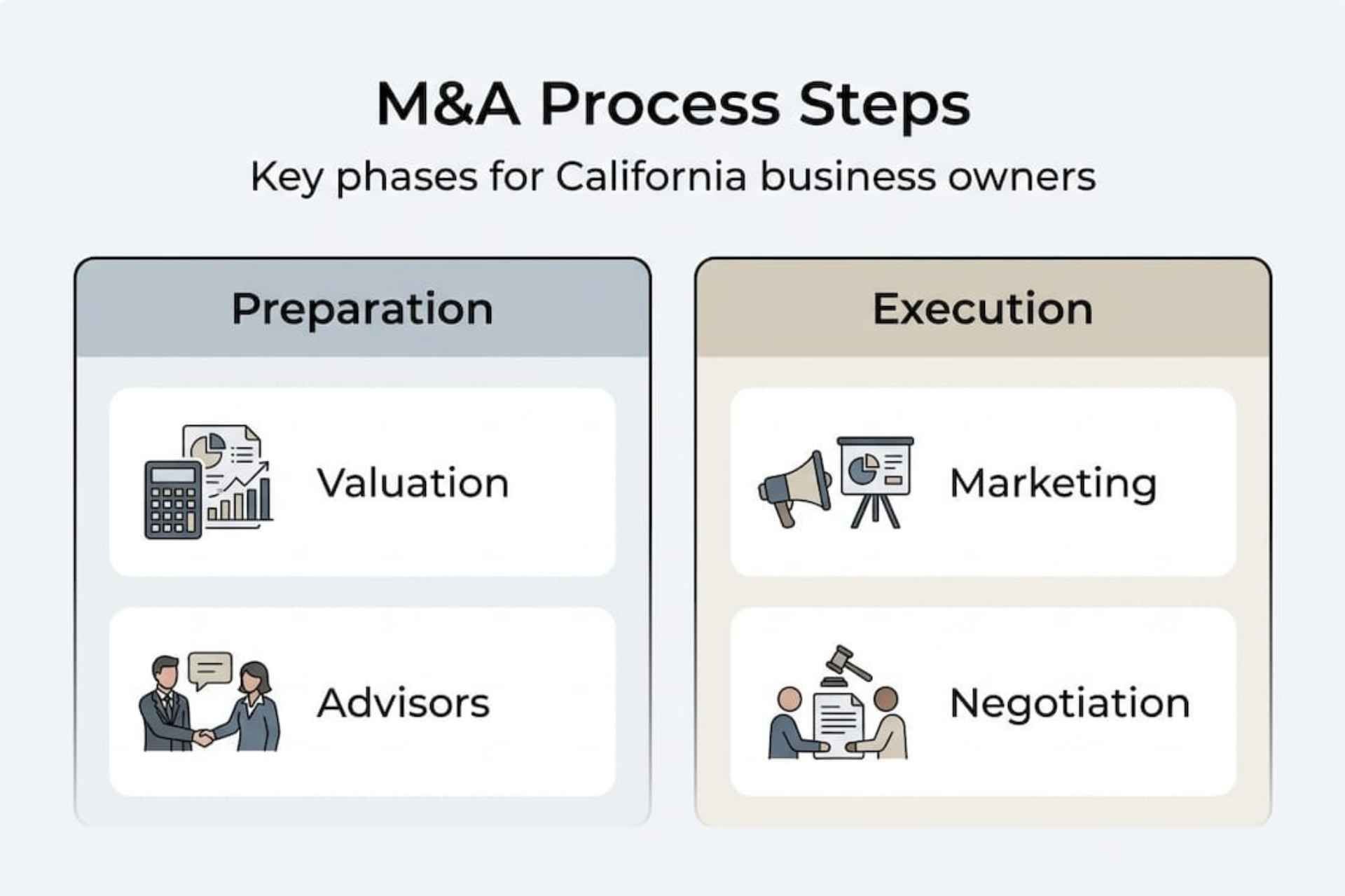
The typical M&A journey unfolds across five distinct phases:
- Preparation involves organizing financials, addressing operational weaknesses, and assembling your advisory team
- Marketing means confidentially reaching qualified buyers while protecting business continuity
- Negotiation encompasses offer evaluation, term sheet development, and purchase agreement drafting
- Due diligence requires providing comprehensive documentation for buyer verification
- Closing finalizes legal transfers, fund distribution, and ownership transition
Each phase builds on the previous one, creating a logical progression from initial decision to final handshake. The entire process typically spans six to twelve months for lower middle market ($2m to $25m in annual revenues) California businesses, though the timeline varies based on business complexity, market conditions, and deal structure.
Rushing through stages or skipping preparation steps almost always reduces the final sale price or increases the risk of deal failure.
Step-by-Step Guide to the M&A Process for California Lower Middle Market Businesses
Navigating the M&A landscape requires understanding what happens at each stage and what you need to accomplish before moving forward. Here's how successful California business owners approach each phase.
- Preparation and financial cleanup: Before approaching any buyers, organize three years of financial statements, tax returns, and operational metrics. Clean up accounting inconsistencies, document revenue sources, and identify any legal or compliance issues that could raise red flags. This groundwork typically takes two to four months, but proper preparation directly impacts negotiation success and final valuation.
- Business valuation and approach selection: Engage professional valuators to assess your company using income, market, and asset-based methods. California lower middle market businesses typically receive valuations between 3x and 6x EBITDA, depending on industry, growth trajectory, and market position. Understanding your realistic value range prevents disappointment and helps filter serious buyers from tire kickers.
- Confidential marketing to qualified buyers: Work with M&A advisors to create compelling marketing materials, identify strategic and financial buyers, and initiate confidential outreach. Effective marketing attracts multiple qualified buyers, creating competitive tension that drives higher offers. This phase typically generates initial interest within 30 to 60 days.
- Offer management and negotiation tactics: Evaluate letters of intent based on price, terms, buyer capability, and cultural fit. Negotiate purchase price, earnout provisions, non-compete agreements, and transition support requirements. Strong negotiation often adds 10% to 20% to initial offers through creative deal structuring.
- Due diligence execution: Buyers will scrutinize financials, customer contracts, employee agreements, intellectual property, regulatory compliance, and operational systems. Prepare a comprehensive data room with organized documentation. Expect 60 to 90 days of intensive information requests and site visits.
- Deal closing and ownership transfer: Finalize purchase agreements, complete legal filings, arrange fund transfers, and execute transition plans. California transactions require specific disclosures and regulatory compliance. Plan for 30 to 45 days between signed agreements and final closing.
Pro Tip: Engage experienced M&A advisors 12 to 18 months before your target exit date. Early involvement allows time to address valuation gaps, strengthen financial performance, and position your business for maximum buyer appeal.
Common Deal Structures and How They Impact Your Sale Outcome
How you structure your deal matters just as much as the headline purchase price. California business owners face critical decisions about asset sales, stock sales, or merger arrangements, each carrying distinct tax consequences and liability implications.

An asset sale involves the buyer purchasing specific business assets like equipment, inventory, customer lists, and intellectual property while leaving liabilities with the selling entity. A stock sale transfers ownership of the entire corporate entity, including all assets and liabilities.
Mergers combine two businesses into a single entity, though less common in lower middle market transactions. Asset versus stock sale decisions significantly influence your tax obligations and post-sale exposure.
Here's how they compare:
| Deal Structure | Tax Impact | Liability Transfer | Complexity |
|---|---|---|---|
| Asset Sale | Higher seller taxes (ordinary income on some assets); buyer gets depreciation benefits | Seller retains corporate liabilities; cleaner for buyer | Moderate (individual asset transfers) |
| Stock Sale | Lower seller taxes (capital gains treatment); no buyer depreciation step-up | All liabilities transfer to buyer | Lower (single entity transfer) |
| Merger | Variable based on structure; potential tax-free treatment | Depends on merger type | Higher (regulatory requirements) |
Don't have time to read more?
Take a shortcut and play the video overview below
When evaluating deal structures, consider these factors:
- California state tax rates add 13.3% for high earners on top of federal obligations
- Asset sales allow buyers to allocate the purchase price for favorable depreciation
- Stock sales provide cleaner exits but may require seller representations and warranties
- Earnout provisions tie future payments to performance metrics, affecting risk and tax timing
- Non-compete agreements and consulting arrangements create additional income streams with different tax treatment
Pro Tip: Consult California tax advisors before accepting any letter of intent. Deal structure negotiations often yield more tax savings than purchase price increases, and restructuring after signing becomes nearly impossible.
How to Prepare Your Business and Yourself For a Successful M&A Exit
Successful exits require preparing both your business operations and your personal readiness for life after the sale. Start with these business improvements:
- Document all operational procedures and reduce owner dependency on daily operations
- Strengthen customer diversification to eliminate concentration risk (no single customer over 15% of revenue)
- Upgrade financial reporting systems to provide monthly statements and key performance metrics
- Resolve outstanding legal issues, including litigation, regulatory compliance gaps, or intellectual property disputes
- Formalize employee agreements with clear roles, compensation structures, and non-compete provisions
- Clean up balance sheets by removing personal expenses and normalizing owner compensation
These improvements typically increase business value by 20% to 40% while simultaneously reducing buyer concerns during due diligence.
Preparing yourself for transition involves different considerations:
- Define your post-sale vision: Clarify whether you want complete retirement, part-time consulting, new business ventures, or philanthropic pursuits. Your goals influence deal structure and transition terms.
- Arrange personal financial planning: Work with wealth advisors to model post-sale cash flows, investment strategies, estate planning, and tax optimization. Understand exactly how much you need to maintain your desired lifestyle.
- Build your advisory team early: Assemble M&A advisors, tax accountants, estate attorneys, and wealth managers at least 12 months before marketing your business. Professional advisory input reduces risks and typically increases final proceeds.
- Prepare emotionally for change: Selling a business you built creates identity shifts and emotional challenges. Consider executive coaching or peer support groups to process the transition.
- Plan knowledge transfer processes: Document institutional knowledge, customer relationships, and operational insights that buyers need for successful transitions. Your cooperation during handoff periods often determines earnout achievement.
Pro Tip: Start personal financial planning before business valuation. Knowing your financial freedom number helps you evaluate offers objectively rather than emotionally, preventing premature exits or unrealistic price expectations.
Choosing the right M&A advisor represents your most important preparation decision. Look for professionals with California lower middle market experience, industry expertise in your sector, proven track records with businesses in your revenue range, and fee structures aligned with successful outcomes.
The difference between mediocre and excellent advisors often equals hundreds of thousands of dollars in final proceeds.
Discover Premier M&A Advisory Services For California Lower Middle Market Businesses
Navigating the complexities of selling your California business requires more than general knowledge. You need specialized expertise that understands lower middle market dynamics, California regulatory requirements, and buyer expectations specific to your industry.
Our comprehensive M&A learning center provides California business owners with detailed guides, valuation tools, and strategic frameworks designed specifically for businesses generating $2 million to $50 million in annual revenue.

Whether you're beginning exit planning or actively marketing your business, our mergers and acquisitions advisory services connect you with experienced professionals who maximize value while minimizing transaction risks. Explore our business valuation guide to understand what your company is worth and how to position it for premium offers that reflect your decades of hard work.
Frequently Asked Questions
What is an M&A process?
The M&A process is a structured series of steps involved in buying, selling, or merging businesses, including preparation, valuation, marketing, negotiation, due diligence, and closing. For California lower middle market businesses, this process typically spans six to twelve months. It requires coordination among owners, advisors, buyers, and legal professionals to transfer ownership while maximizing value successfully.
How long does the M&A process take for California businesses?
Most California lower middle market M&A transactions require six to twelve months from initial preparation to final closing. Preparation and valuation consume two to four months, marketing and negotiation take two to three months, due diligence spans 60 to 90 days, and closing requires an additional 30 to 45 days. Complex businesses or challenging market conditions may extend timelines to 18 months.
Should I choose an asset sale or stock sale structure?
Asset sales typically benefit buyers through depreciation advantages but create higher tax burdens for sellers due to ordinary income treatment on certain assets. Stock sales offer sellers favorable capital gains treatment but transfer all liabilities to buyers, who lose depreciation benefits. California sellers often prefer stock sales for tax efficiency, while buyers favor asset sales for liability protection, making this a key negotiation point requiring professional tax guidance.
What are the biggest mistakes California business owners make during M&A?
Common pitfalls include starting preparation too late, overvaluing their business based on emotional attachment, failing to document financials properly, negotiating without professional advisors, accepting the first offer without creating competitive tension, and inadequately preparing for due diligence scrutiny. These mistakes typically reduce final sale proceeds by 20% to 40% compared to well-prepared transactions with expert guidance.
Do I need an M&A advisor to sell my California business?
While not legally required, M&A advisors typically increase final sale proceeds by 15% to 30% while reducing transaction risks and timeline. Professional advisors provide accurate valuations, access to qualified buyer networks, negotiation expertise, due diligence management, and deal structure optimization that individual owners cannot replicate. For lower middle market California businesses, advisory fees generally represent 3% to 8% of transaction value, delivering strong return on investment through higher sale prices and smoother processes.
Hey there! Can we send you a gift?
We just wanted to say hi and thanks for stopping by our little corner of the web. :) we'd love to offer you a cup of coffee/tea, but, alas, this is the Internet.
However, we think you'll love our email newsletter about building value and properly position your company before transition/exit your business ownership.
As a special welcome gift for subscribing, you'll also get our helping and educational guides, tips, tutorials, etc.. for free.
It's filled with the best practices for retiring serial business owners like Dan Gilbert, Larry Ellison, Warren Buffett, and many more.
Just sign up for our emails below.