Exit Planning vs Succession Planning for California Business Owners: How to Decide (with ESOP vs Third‑Party Sale under California Taxes)
Comparing Exit Planning vs Succession Planning for California Business Owners
You’re weighing your options: sell to an external buyer for maximum liquidity or transition ownership to employees or insiders to preserve legacy. The stakes are high because, in California, taxes and closing mechanics can shift your walk‑away dollars and your timeline more than you might expect.
This guide compares exit planning vs succession planning through a single, practical lens: which path is most likely to maximize your after‑tax, walk‑away proceeds under California rules—while still fitting your goals for people, timing, and risk. We’ll define core terms, explain California’s unique tax overlay, compare ESOP vs third‑party sale dynamics, and give you a step‑by‑step way to decide within a 6–24‑month horizon.
If you’ve been told “ESOPs always win on taxes” or “third‑party buyers always pay more,” here’s the deal: either can deliver the better owner outcome depending on structure, eligibility, and your California‑specific facts.
Guide Context
For context on who this guide is written for: Rogerson Business Services’ ideal client is a California business owner planning an exit or sale, typically with $2 million to $50 million in annual revenue, in industries such as manufacturing, construction, managed IT services, industrial services, business services, healthcare, logistics and transportation, and wholesale distribution.
This guide is also informed by the perspective of Andrew Rogerson—a California M&A advisor with 20+ years in the market and credentials including Certified Mergers & Acquisition Professional (CM&AP)—see the firm’s About page.
Let’s dig in.
Key Takeaways
- California taxes capital gains as ordinary income, so your “headline price” can overstate what you actually keep.
- An ESOP can deliver liquidity, but pricing is capped at fair market value, even if a strategic buyer might pay a premium.
- §1042 can defer federal and California tax in a C‑corp ESOP sale, but eligibility and QRP reinvestment rules must be met.
- Asset vs stock structure can change your federal tax character (especially depreciation recapture), which then flows through to California.
- Model net, after‑tax walk‑away proceeds across ESOP, stock sale, and asset sale scenarios before you commit.
- California closing steps can extend timelines (CDTFA close‑outs, bulk sales notices, license transfers), so plan for escrow timing and leakage.
Exit planning vs succession planning — owner outcomes
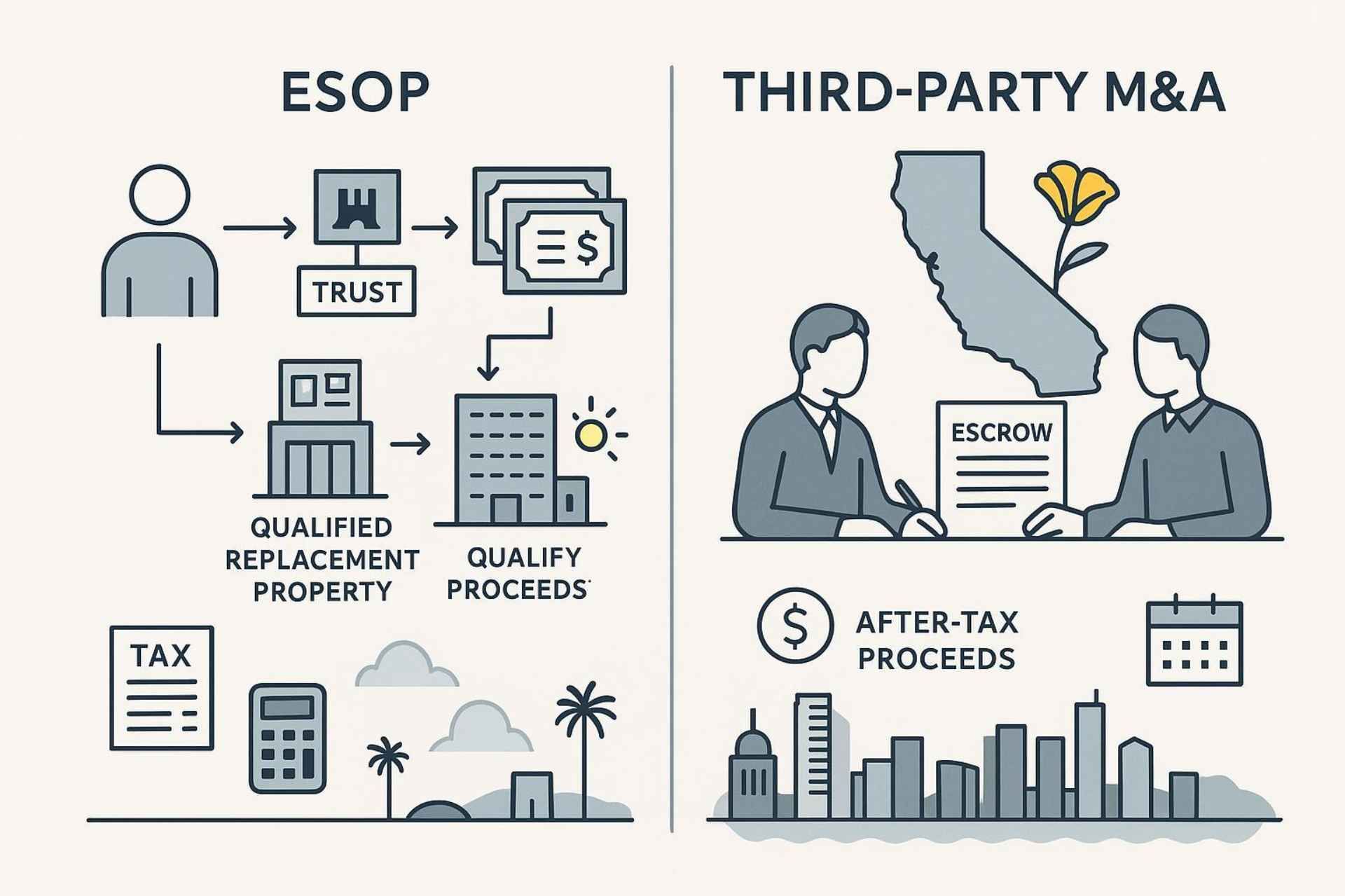
Exit planning prioritizes liquidity for the owner, usually through a sale to an external buyer (strategic acquirer, private equity, financial sponsor) and often results in a full or majority divestiture on a defined timeline. Succession planning prioritizes continuity—keeping leadership, culture, and customer relationships stable—by transitioning ownership internally over time (next‑generation family, management buyout, or an employee stock ownership plan, i.e., ESOP). An ESOP can blur the lines: it’s technically a succession mechanism that can also deliver meaningful liquidity, but pricing is capped at fair market value through an independent appraisal.
When this article refers to the “lower middle market,” it’s using a practical owner lens: California companies often in the $2M–$50M annual revenue range—frequently in manufacturing, construction, managed IT services, industrial services, business services, healthcare, logistics and transportation, and wholesale distribution—where after‑tax outcomes and deal structure choices tend to matter as much as the headline price.
If you want a deeper conceptual primer before modeling numbers, see the internal comparison in Exit vs Succession Planning: The Ultimate Comparison from the same publisher for additional context:Exit vs Succession Planning.
California taxes and deal basics that shape net proceeds
California treats capital gains as ordinary income—there’s no preferential state rate. That single fact can materially change the outcome of exit planning vs succession planning for a California owner. The Franchise Tax Board’s 2024 instructions state plainly that California taxes long‑ and short‑term capital gains as regular income. See the FTB 2024 Schedule CA (540) Instructions for the baseline rule.
At the federal level, long‑term capital gains are taxed at 0%/15%/20% depending on income; many sellers also owe the 3.8% Net Investment Income Tax when MAGI crosses statutory thresholds. For details and thresholds, review the IRS Net Investment Income Tax overview and the current Instructions for Form 8960.
Because federal brackets and NIIT thresholds can change, treat any rate assumptions as inputs to update with your advisor for the year you expect to close.
Deal structure matters:
- Asset vs stock sale: Buyers often prefer asset deals for a tax basis “step‑up,” while sellers usually prefer stock sales for simpler taxation. Asset deals require allocating price across asset classes (federal Form 8594; residual method) and can increase the portion of gain taxed as ordinary income due to depreciation recapture. Reference: IRS — About Form 8594. California overlays ordinary‑income rates on the state side and may require adjustments if state and federal depreciation differ.
- Entity type: S‑corps typically see pass‑through single‑level tax to shareholders. C-corporations can face corporate‑level tax on asset‑sale gains plus shareholder‑level tax on distributions—raising the importance of stock‑sale negotiations or ESOP‑specific alternatives.
For fundamentals on California capital gains in the business‑sale context, this internal explainer offers additional background: Is Selling a Business Considered Capital Gains in California? and a companion primer, How Much Is Capital Gains Tax in California (Selling a Business).
Don't have time to read more?
Take a shortcut and play the video overview below
ESOP vs third‑party sale in California — side‑by‑side
Owners often compare ESOPs to third‑party sales because both can deliver significant liquidity. The table below summarizes high‑level trade‑offs that influence after‑tax, walk‑away proceeds, speed/certainty, and legacy.
| Dimension | ESOP (employee stock ownership plan) | Third‑party sale (strategic/PE/individual) |
|---|---|---|
| Pricing | Fair market value only via independent appraisal; trustees cannot pay above FMV (see ESOP Association — ESOP Basics). | Potentially includes strategic premium due to synergies/competition; not guaranteed and varies by buyer and process. |
| Taxes on seller | Potential deferral of federal and California tax on gain via IRC §1042 if eligibility is met (C‑corp stock; 30%+ sale; reinvestment in Qualified Replacement Property within window). CA conforms to §1042; see FTB — Summary of Federal Income Tax Changes. | Generally pay federal LTCG and NIIT if applicable; California taxes gain at ordinary‑income rates. Asset deals may increase ordinary‑income portions via recapture. |
| Speed & certainty | 6–12 months typical; trustee selection, feasibility, financing, and ERISA‑conservative processes add steps; usually fewer external third‑party diligence demands. | 6–12+ months typical; speed varies by buyer type, industry, financing, and California‑specific consents/clearances; auctions may take longer. |
| Continuity & culture | Strong continuity; employees become beneficial owners; governance and repurchase obligations require planning. | Depends on buyer; strategics may integrate; PE may retain team with incentives; continuity can vary widely. |
| Complexity & cost | Specialized counsel, trustee, valuation, financing, administration; ongoing repurchase obligations post‑close. | Broad diligence, working‑capital mechanics, potential rollover equity, escrows/earn‑outs; integration risk. |
Section 1042 and ESOP feasibility — what it takes
If your company is a C corporation and you’re considering an ESOP, Internal Revenue Code §1042 can be a powerful lever. When eligibility rules are met, sellers can elect to defer gain by reinvesting sale proceeds into Qualified Replacement Property (QRP) during a 15‑month window (three months before through 12 months after the sale). California conforms to §1042, so a properly executed election can defer state recognition of gain as well. See the FTB’s Summary of Federal Income Tax Changes for the conformity note and the statute text at IRC §1042 via Cornell Law. For mechanics and common pitfalls, review practitioners’ summaries like RSM’s §1042 overview and BDO’s ESOP FAQs.
Key feasibility signals include stable profitability, sufficient payroll to support ESOP contributions or debt service, a strong management bench, and readiness to adopt ESOP governance and administration. Remember, ESOP pricing is FMV only—trustees may not pay a strategic premium. That constraint is well established by the ESOP Association’s FMV guidance and the National Center for Employee Ownership’s resources.
Asset sale vs stock sale — tax and structure implications in California
In many lower middle‑market ($2M to $25M in annual revenue) deals, buyers push for asset purchases to secure a basis step‑up and isolate liabilities. Sellers usually prefer stock deals to simplify taxation and avoid ordinary‑income recapture on certain asset classes. Asset sales trigger a purchase‑price allocation (Form 8594) across asset classes; portions tied to previously depreciated equipment can be taxed as ordinary income federally, with California layering ordinary‑income rates at the state level. Review IRS — About Form 8594 for the allocation framework. If you operate as a C‑corp and sell assets, contrast the outcome with a stock sale or ESOP path to avoid potential double taxation (corporate‑level tax on gain plus shareholder‑level tax on distributions). A high‑level transaction‑tax primer from a national firm provides helpful contrasts: PKF O’Connor Davies — Stock vs. Asset Sale.
Model your after‑tax, walk‑away proceeds (with examples)
Your decision should rest on modeled, owner‑specific numbers. The goal is to compare exit planning vs succession planning options on a net, after‑tax basis—under realistic California assumptions—while accounting for fees, escrows, working‑capital adjustments, and any rollover equity.
A practical modeling sequence looks like this:
- Estimate enterprise value and equity value: normalize EBITDA, apply a range of market multiples, subtract net debt, and adjust for working capital. If you need a refresher on methods, see the internal primers Business Valuation Methods and the step‑through Seven‑Step Tutorial for Valuing Your Business.
- Choose structure scenarios: ESOP §1042 (if eligible), third‑party stock sale, third‑party asset sale. Note any expected buyer premium for third‑party scenarios and a realistic FMV range for ESOP pricing.
- Layer transaction costs: investment banking/advisory, legal, accounting, QoE, trustee/valuation (ESOP), financing fees.
- Apply federal taxes: LTCG rates to capital portions; NIIT if thresholds are met; ordinary‑income treatment to depreciation recapture portions in asset sales.
- Apply California taxes: tax all gains under ordinary‑income rates; adjust for any state‑federal basis differences as needed. If electing §1042 and eligible, model state deferral in sync with federal deferral.
- Reflect escrows/holdbacks, earn‑outs, and any rollover equity that delays or risks cash realization.
- Stress‑test timelines and certainty: longer processes can increase leakage (interest expense, advisor burn, operational distraction); California clearances can delay disbursements held in escrow.
If you’re a California owner (roughly $2M–$50M revenue), a sell‑side advisor can help keep the model grounded in market‑realistic assumptions (working capital targets, buyer structure preferences, and the fee/escrow stack). That’s the kind of net‑proceeds work firms like Rogerson Business Services typically support alongside valuation and process planning.
Illustrative scenarios (simplified for clarity; your actuals will vary):
- Scenario A — $2M equity value, S‑corp, stock sale to a third party: Apply federal LTCG rate based on income, assess NIIT applicability, then apply California ordinary‑income tax to the gain; net may be meaningfully below headline price after fees.
- Scenario B — $8M equity value, C‑corp, ESOP at FMV with §1042: Price at independent FMV without premium; if §1042 eligible and QRP reinvestment is executed within the window, model deferral at both federal and California levels. Compared to a hypothetical third‑party premium, the winner can flip depending on the premium size vs tax deferral value.
- Scenario C — $30M enterprise value with significant equipment: In an asset sale, allocate price via Form 8594; model ordinary‑income recapture on equipment portions federally and layer California ordinary‑income treatment; in a stock sale, recapture impact may be lower but weigh buyer discount for lack of basis step‑up; in an ESOP, enforce FMV and test §1042 eligibility.
As you refine assumptions, you may also want a machinery and equipment valuation for allocation support and diligence: Machinery & Equipment Valuation Guide.
Speed and certainty of close in California — what slows deals and how to plan
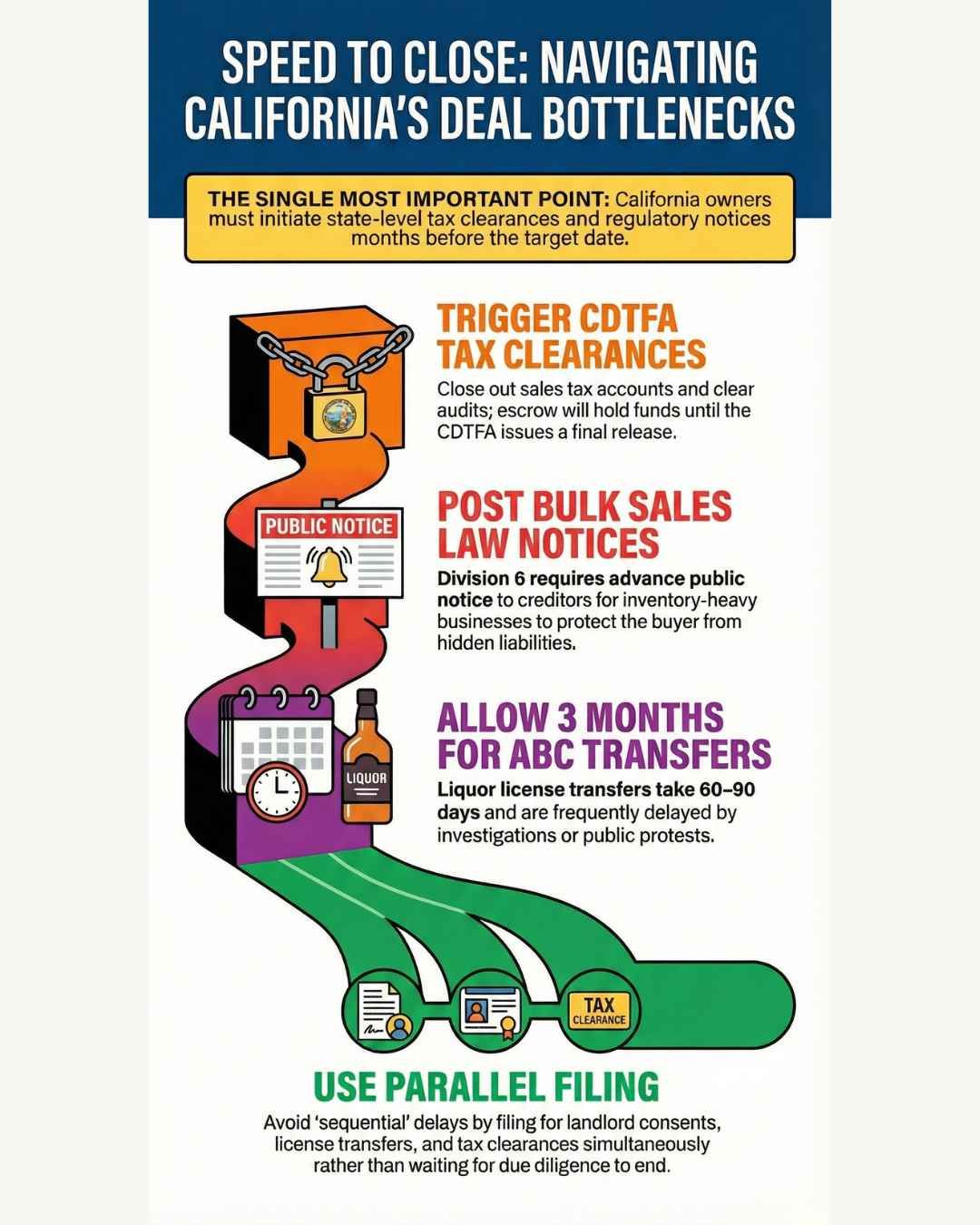
California closings can be extended by tax clearances, public‑notice windows, and license transfers. Planning around these steps can protect your net proceeds by reducing delays, interest costs, and escrow surprises.
- CDTFA close‑out: When you discontinue or sell, you must close out your sales and use tax account, file a final return, and address any audits. Escrow often holds funds pending clearance. Timelines vary and can stretch to several weeks or more. See CDTFA Publication 74 — Closing Out Your Account for process guidance.
- California Commercial Code Division 6 (Bulk Sales Law): For certain sales of inventory‑heavy businesses that are not in the ordinary course of business, Division 6 imposes notice and creditor‑protection requirements. The statute requires advance notice—Cal. Com. Code §6106.2 describes timing—and includes exemptions outlined in §6102. Review the official text at §6106.2 and §6102 with counsel to determine applicability and timing.
- License transfers (example: Alcoholic Beverage Control): Person‑to‑person license transfers commonly take roughly two to three months and can be delayed by protests or investigations. Start early and keep escrow compliant. See California ABC — Person‑to‑Person Transfer and the ABC license application requirements.
Mitigation starts with early mapping of required consents and clearances, parallel filing wherever permitted, tight escrow instructions for tax and creditor risks, and a realistic, pre‑negotiated timeline with your buyer, trustee, lenders, and advisors.
How to decide — a practical framework for the next 6–24 months
Start with your non‑negotiables. Do you prioritize maximum liquidity now, or do you want employee continuity and cultural stability even if the cash comes in stages? Are you comfortable trading a potential premium for tax deferral and governance obligations—or vice versa?
Then move through a structured sequence:
- Goals and constraints: Rank liquidity, legacy, control, and speed. Document any post‑close roles you want to keep.
- Structure fit: Identify whether you can (and should) qualify for §1042 via a C‑corp ESOP. If not, test third‑party stock vs asset paths with realistic buyer behavior.
- After‑tax modeling: Compare scenarios side by side—ESOP FMV with §1042 vs third‑party sale with or without premium—using federal LTCG/NIIT and California ordinary‑income assumptions. Ensure you include fees, escrows, and any rollover.
- Speed/certainty plan: Overlay California clearances and consents on your ideal timeline; decide if the added complexity of a third‑party sale or the specialized governance of an ESOP better fits your risk tolerance.
- People plan: Consider management depth, repurchase obligations in an ESOP, and integration impacts in a strategic sale.
Two questions to pressure‑test your choice: If the premium a buyer offers were 0–10%, would §1042 deferral still yield a better net today? And if California clearances added 60–90 days, which structure would cause less operational strain or escrow leakage for you?
Proof points from California third‑party exits (case studies)
If you’re leaning toward an external exit, it helps to sanity‑check your expectations against real, recent outcomes. Below are examples of third‑party sales documented in the site’s case‑study library (prices, timelines, and friction points vary by industry and company specifics):
- IT services (MSP) — sold for $525K; closed in ~7 months. Case study:How to Sell an IT Services Company in Seven Months.
- Portable sink manufacturer (Bay Area) — closed escrow in ~5 months (third‑party buyer). Case study:Quick Sale of Portable Sink Manufacturer (Bay Area, CA).
- A “failed sale” example (roofing, Northern California) — strong interest, but the process ultimately paused/withdrew. This is useful as a cautionary baseline for pricing and readiness. Case study:The $3 Million Mistake: Why a Northern California Roofing Business Failed to Sell.
For more examples across industries and deal sizes, see the full list:Selling Businesses Case Studies.
Choosing advisors & next steps
You’ll need a coordinated deal team: M&A advisor or investment banker, tax CPA, transaction attorney (and ERISA counsel for ESOPs), valuation specialists, and, in regulated sectors, licensing experts. Advisors experienced in California closings can help sequence CDTFA close‑outs, bulk sales notices where applicable, and landlord or franchisor consents to protect both price and timing. For an overview of marketing and process roles, see the internal resources Marketing The Deal and a primer on team responsibilities at the Deal Team hub.
Advisors who focus on California lower‑middle‑market exits can support valuation, after‑tax modeling, and regulatory navigation (example: Rogerson Business Services). The team is led by Andrew Rogerson (CM&AP), a California M&A advisor with 20+ years in the market—see About for background. Keep the tone of engagement objective and numbers‑driven, and ask for side‑by‑side net‑proceeds models before you commit to a path.
FAQs
Does §1042 always beat a third‑party sale on a net basis?
No. ESOPs transact at FMV; a strong third‑party process can produce a premium. The winner depends on your eligibility for §1042, the size of any premium, your fee stack, deal structure, and California taxes. Compare scenarios using consistent assumptions.
We’re an S‑corp—can we use §1042?
§1042 applies to sales of C‑corp stock. Some owners consider converting to C‑corp status to pursue an ESOP, but conversion timing and tax effects are complex; consult tax counsel and review the statute at IRC §1042 before planning feasibility steps.
What is Qualified Replacement Property (QRP) and what’s the timing?
QRP generally includes securities of U.S. operating companies. Sellers must reinvest during a 15‑month window around the sale. Dispositions or certain pledges of QRP can trigger recognition of deferred gain; see IRS Rev. Rul. 2000‑18 for technical consequences and consult advisors for portfolio construction.
How do California taxes affect my choice between asset and stock deals?
California taxes gains as ordinary income regardless, but asset deals can increase the ordinary‑income portion federally due to depreciation recapture, which also flows to California. Review allocations on IRS Form 8594 guidance and model both scenarios.
What California steps most often slow down closings? or Question
CDTFA close‑outs and audits, Division 6 bulk‑sales notice windows for inventory‑based businesses, certain license transfers (e.g., ABC), and landlord or franchisor consents. Plan filings early and structure escrow to reduce surprises. See CDTFA Publication 74 and Cal. Com. Code §6106.2.
Where can I learn more about the basics of California capital gains on business sales?
For an accessible overview from this site, see Is Selling a Business Considered Capital Gains in California? and How Much Is Capital Gains Tax in California (Selling a Business).
Educational note: This guide is for general information only and isn’t tax, legal, or investment advice. Deal structures, eligibility rules (including §1042), and tax outcomes depend on your facts and your filing year—confirm specifics with your CPA and transaction counsel.
Last reviewed: 2026-02-28.
Choosing between exit planning vs succession planning ultimately comes down to disciplined modeling under California’s rules, a clear view of your goals, and a realistic plan for speed and certainty.
Build your model, map the regulatory path, and pressure‑test assumptions with your advisors before setting your course. The right decision is the one that delivers the best after‑tax, walk‑away proceeds while honoring the future you want for your company—and does so on a timeline you can live with.
Ready for a conversation?
Contact Us
Hey there! Can we send you a gift?
We just wanted to say hi and thanks for stopping by our little corner of the web. :) we'd love to offer you a cup of coffee/tea, but, alas, this is the Internet.
However, we think you'll love our email newsletter about building value and properly position your company before transition/exit your business ownership.
As a special welcome gift for subscribing, you'll also get our helping and educational guides, tips, tutorials, etc.. for free.
It's filled with the best practices for retiring serial business owners like Dan Gilbert, Larry Ellison, Warren Buffett, and many more.
Just sign up for our emails below.