
Due Diligence Documents Checklist For Selling A $5–10M Business (California)
Due Diligence Documents Checklist
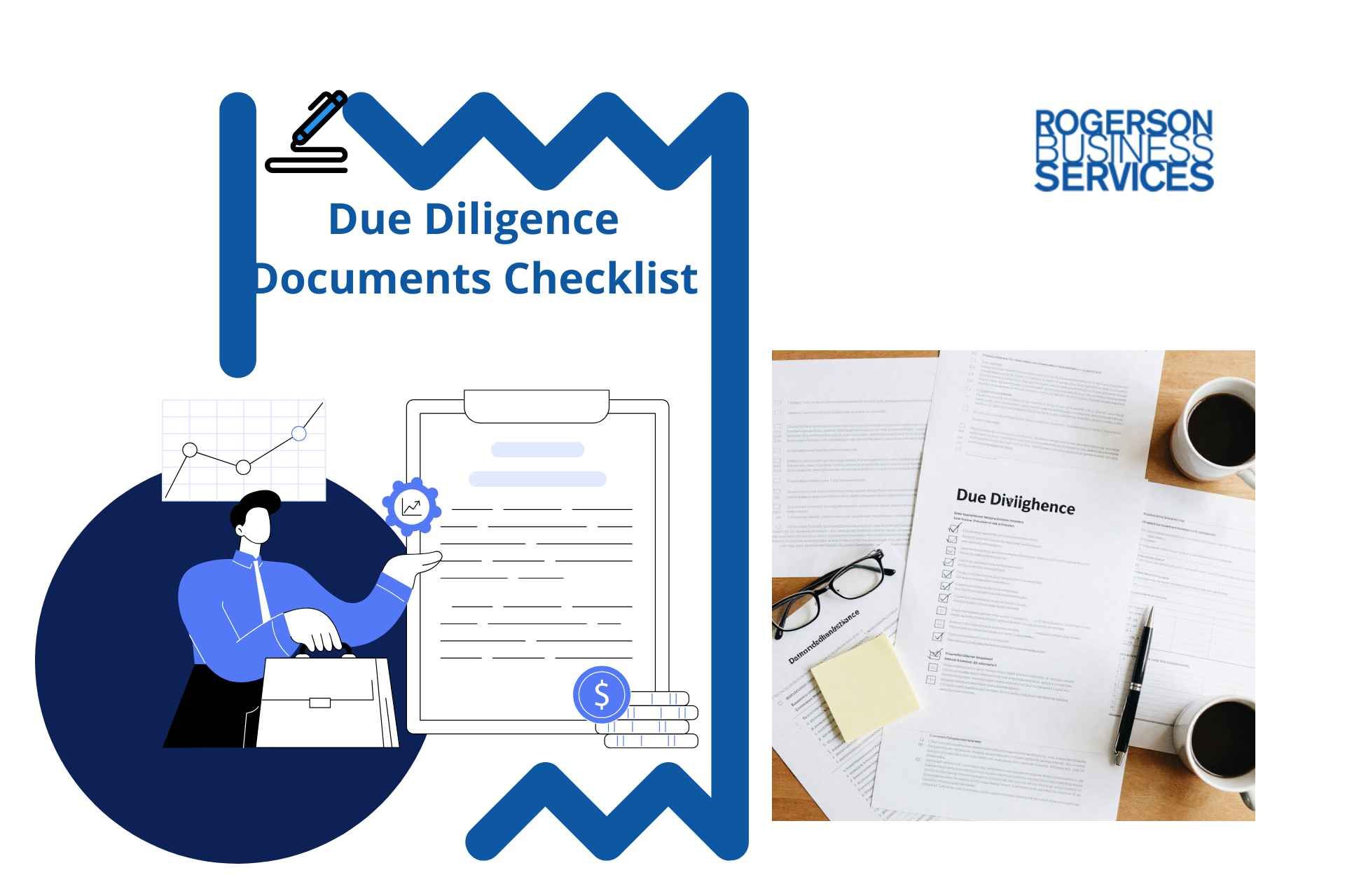
Selling a $5–10M California business often turns on one unglamorous factor: how fast you can answer diligence questions without losing control of confidentiality. Buyers don’t ask for documents because they like paperwork, but because they need to validate earnings, contracts, and risks before they finalize price and terms.
So if you want a calmer process, build a seller-ready data room index before a buyer’s deal team starts firing requests. Then you can respond quickly, but you can also share information in stages and keep sensitive items protected.
Key Takeaway: A clean, numbered data room can reduce diligence drag because it makes your answers consistent, searchable, and repeatable.
Where diligence fits in a California sale

Diligence usually accelerates after a buyer signs an LOI (letter of intent). However, buyers form their first real opinion of “deal risk” earlier, so you can protect leverage if you prepare early.
If you want the broader roadmap, start with Rogerson Business Services’ guide to the steps to sell a business in California, and then review how long it takes to sell a business so you can plan for the document workload.
Before you upload anything: set confidentiality rules and a sharing sequence
A checklist alone won’t protect you unless you control access. So set the rules first, and then load documents.
Use a virtual data room and number your folders
Pick one secure location, and then mirror a buyer’s request list with a simple folder tree. iDeals’ overview of a data room checklist shows the standard category approach, and that structure works because it matches how diligence teams think.
Share in phases, not all at once
Release less sensitive items first, and then unlock deeper folders after you qualify the buyer and confirm seriousness. Valutico’s sell-side prep guide emphasizes staged sharing and a single Q&A log in its sell-side due diligence checklist, which reduces confusion because everyone works from the same answers.
Keep certain items offline until timing makes sense
You can keep items like customer-level pricing, sensitive employee data, and trade secrets offline early, but you still should list them in the index so you remember them and so your advisor can plan the release.
If you plan to run a controlled, confidential process, review Rogerson Business Services’ guidance on selling privately and controlling access before you share sensitive files.
Due diligence documents checklist: a sell-side data room index you can copy
Use the index below as your starting folder tree. Then treat every line as a Yes/No readiness check: either you have it, or you need to create it.
Data room index template (copy/paste)
| Folder # | Section | Include these documents (examples) | Ready? (Y/N) |
|---|---|---|---|
| 1 | Executive overview | Business summary, org chart, locations list, product/service list, KPI snapshot | |
| 2 | Financials | 3–5 years P&L, balance sheet, cash flow (if you have it), YTD interim P&L and balance sheet, trial balance, monthly financial package | |
| 3 | Revenue detail | Revenue by customer/product, top-customer list, backlog or pipeline, price lists, credit memo summary | |
| 4 | Working capital | A/R aging, A/P aging, inventory aging, deferred revenue (if applicable), seasonal notes | |
| 5 | Banking and debt | Bank statements, debt schedule, loan agreements, liens/UCC info, equipment leases | |
| 6 | Tax | Federal and California returns, sales/use tax filings (if applicable), payroll tax filings, tax notices and audit correspondence | |
| 7 | Corporate records | Formation docs, bylaws/operating agreement, cap table or ownership schedule, board/member consents, minutes, DBA filings | |
| 8 | Material contracts | Top customer agreements, supplier/vendor contracts, leases, insurance policies, loan covenants, change-of-control clauses list | |
| 9 | HR and benefits | Employee census, handbook, offer letters, employment agreements, contractor agreements, benefits summary, workers’ comp, any open claims | |
| 10 | Legal and compliance | Permits/licenses, litigation summary, settlements, IP filings, policies (anti-harassment, safety), key notices | |
| 11 | IT, data, and security | Software licenses, IT vendor contracts, cybersecurity policy, incident log, backup/disaster recovery plan, privacy policies | |
| 12 | Real estate and environmental | Deeds or leases, rent schedule, maintenance logs, Phase I ESA (if relevant), environmental notices | |
| 13 | QoE inputs | Monthly financials, customer concentration analysis, margin bridge, revenue recognition notes (if needed), working capital trend support | |
| 14 | EBITDA add-backs support | Add-back schedule, invoices/receipts, GL detail, proof of payment, related-party agreements, memos per add-back | |
| 15 | Diligence tracker | Buyer request log, Q&A log, document version notes, disclosure schedule draft |
Pro Tip: Name files with dates so you can sort quickly (for example,
2025-12_P&L.pdf
and
2026-03_AR-aging.xlsx). Then keep one “Read Me First” index at the top of each folder.
Financials buyers treat as non-negotiable in a $5–10M sale
Buyers will ask for many things, but your financial package drives confidence faster than anything else.
Use this “minimum financial package” checklist
- Provide 3–5 years of annual financial statements and tax returns.
- Provide YTD interim statements through the most recent month-end.
- Provide a trial balance, and then keep it consistent with your P&L line items.
- Provide A/R and A/P aging, and explain large or old balances.
- Provide inventory detail and valuation method if you carry inventory.
- Provide a debt schedule and loan documents.
If you want to sanity-check how buyers translate your financials into price, review the Rogerson Business Services guide to business valuation.
QoE inputs and add-back documentation buyers will test
A buyer’s CPA team often runs a QoE (Quality of Earnings) process to answer one question: how repeatable are your earnings after they remove one-time noise?
Put these QoE inputs in one place
- Monthly P&L and balance sheet for 24–36 months.
- Revenue by customer, with retention and concentration notes.
- Gross margin bridge when margins moved meaningfully.
- Headcount and payroll trend support.
- Working capital trend support (A/R, A/P, inventory) and seasonality notes.
Document add-backs like a buyer will audit them
Add-backs can help, but buyers reject “management adjustments” when you can’t prove them. So build an audit trail for each item.
Use this add-back schedule template, and then attach support behind every line.
Add-back schedule template (copy/paste)
| Add-back category | Description | Amount | Month/Year | GL account | Why it won’t recur | Support files (Y/N) |
|---|---|---|---|---|---|---|
| Owner comp | Normalize owner salary/bonus | |||||
| Personal | Personal expense run through company | |||||
| Legal | One-time legal matter / settlement | |||||
| Repairs | One-time emergency repair | |||||
| Professional fees | Transaction or restructuring fees | |||||
| Rent | Related-party rent normalization |
For each add-back, include:
- the invoice or receipt,
- the GL detail showing where you booked it,
- and proof of payment (bank or card).
Also, add a short memo when you expect pushback, because buyers will ask “why won’t this happen again?” and “what would a new owner spend instead?”
⚠️ Warning: Don’t lump unrelated items into one “one-time expenses” line. Buyers often discount credibility when they can’t trace each adjustment cleanly.
Contracts and corporate records to gather early
Buyers often slow down when they find consent issues late, so pull these forward.
Contracts
- Top customer agreements and any master service agreements (MSAs).
- Top supplier and vendor contracts.
- Leases (real estate and equipment).
- Loan agreements and covenants.
- A simple change-of-control list: note which contracts require consent if ownership changes.
Corporate records
- Entity formation documents and amendments.
- Bylaws or operating agreement.
- Ownership schedule and any option, warrant, or profit interest documentation.
- Board/member minutes and written consents.
HR, legal, tax, and California-specific diligence reminders
California buyers often focus on people and compliance items because they can create surprise liability.
HR and employment (California)
Gather your core HR file set, and then do a quick compliance pass.
- Keep an employee census with role, pay type, start date, and location.
- Keep signed offer letters and employment agreements.
- Keep contractor agreements and document classification rationale when you use contractors.
- Keep payroll registers and preserve timekeeping records.
For wage-and-hour context, CalChamber’s HRCalifornia library provides a general overview ofCalifornia wage-and-hour rules. That resource won’t replace legal advice, but it can help you spot which records you should assemble.
Privacy and sensitive data sharing
If you share employee or customer data, set redaction rules and approval steps, because privacy obligations can shape what you share and when you share it. Octillo Law discusses general privacy considerations when sharing employee data during M&A.
California redaction protocol (practical)
Before you upload anything, decide what you will redact, what you will summarize, and what you will hold back until later. In California, privacy expectations are a real diligence factor—especially when you’re sharing employee and customer information.
Use a simple rule set:
- Default to summary tables early: Customer lists without customer-level pricing/margin; employee census without personal identifiers.
- Redact personal information (PII) unless it’s essential: e.g., Social Security numbers, driver’s license/passport numbers, dates of birth, home addresses, personal phone numbers, personal email addresses.
- Use consistent redaction conventions: black-box redactions + a note like “PII redacted” so buyers don’t assume documents are incomplete.
- Create an access escalation path: one person approves releases; track what version went to which buyer.
- Keep the unredacted originals outside the VDR: and only provide them later, to a narrower group, when truly necessary.
Tip: Redaction is about reducing unnecessary exposure, not hiding deal issues. If something is material (for example, an open claim or a key customer contract), disclose it in the right phase with controlled access.
Tax and standing (California)
- Collect federal and California returns and supporting schedules.
- Collect sales/use tax filings if they apply to your business.
- Collect payroll tax filings.
- Collect notices and audit correspondence, and create a simple log of status and next actions.
What belongs in the data room vs. what you keep offline
A buyer needs enough to validate the business, but you still control the order.
Put these in the data room early
- High-level financial package, corporate documents, and a contract index.
- Summary lists (customer list without granular pricing, vendor list, insurance summary).
- Policies and basic compliance documents.
Keep these offline until later (but track them)
- Customer-level pricing and margin by account.
- Highly sensitive employee data and personal information.
- Trade secrets and detailed IP documentation.
- Security details that could increase risk if disclosed broadly.
Two real-world examples: why organization and staged sharing protect your leverage
Here’s one anonymized example from a California manufacturing sale to show why sellers who build the data room early can absorb surprises without losing momentum.
- Industry: Manufacturing (construction-related)
- Deal size: ~$36M transaction (lower middle market)
- What created friction: COVID-era uncertainty, shifting financing requirements, and a large multi-party deal team created repeated stops/starts.
- What helped: Staying organized early, keeping calls and sensitive coordination confidential, and relying on experienced advisors to keep documentation and decisions moving even when the path changed.
- Outcome: Closed successfully after a longer-than-expected process (multiple escrow attempts), with the seller emphasizing that early organization made later changes possible.
Here’s a second anonymized example from a California HVAC (construction/trades) sale that highlights why confidentiality controls and a resilient process matter when deals stall.
- Industry: HVAC (Orange County, California)
- Deal size: ~$3.52M sale
- What created friction: Multiple deals fell through, and lender financing introduced delays, while the seller still needed to protect employees and customer relationships.
- What helped: A tight confidentiality sequence (blind one-page summary → NDA → staged disclosure), a screened buyer pipeline, and keeping financial records current so diligence didn’t reset each time a buyer dropped.
- Outcome: Closed successfully (including seller financing), with confidentiality maintained until the seller’s announcement.
California agencies & primary sources (for verification)
When you’re compiling diligence files, it helps to pull key “standing” and compliance items directly from California’s primary sources:
- California Secretary of State (BizFile Online) — entity status & filings:https://bizfileonline.sos.ca.gov/search
- California Franchise Tax Board (FTB) — business filing information: https://www.ftb.ca.gov/file/business/index.html
- California Department of Tax and Fee Administration (CDTFA) — Sales & Use Tax: https://cdtfa.ca.gov/taxes-and-fees/sutprograms.htm
- California Employment Development Department (EDD) — payroll taxes: https://edd.ca.gov/en/payroll_taxes/
- California Privacy Protection Agency (CPPA) — CPRA resources: https://cppa.ca.gov/
These links are informational starting points—not legal advice, but adding screenshots/PDF exports from the relevant portals can speed up buyer verification and reduce repetitive Q&A.
Mini glossary (so buyers and sellers mean the same thing)
- LOI (Letter of Intent): The buyer’s written outline of price and key terms before final contracts.
- QoE (Quality of Earnings): A CPA-led analysis of how repeatable earnings are after normalizing one-time or non-operating items.
- Add-backs: Expenses added back to EBITDA to reflect normalized earnings—buyers will test these line by line.
- Working capital (and “working capital peg”): The net working capital level the deal assumes at close; deviations can adjust the purchase price.
- Change-of-control clause: Contract language that requires notice/consent if ownership changes.
- CPRA: California Privacy Rights Act; affects how personal information is handled and shared.
Next step: request a fuller checklist and templates (optional)
If you want a more detailed data room index tailored to your industry and entity structure, you can request a fuller checklist from Rogerson Business Services.
If you’re still early in the process, start here: I want to sell my lower mid-market business: where do I start?
By: Rogerson Business Services (California lower middle-market M&A advisory)
About the author/firm: Rogerson Business Services advises owners of $2M–$50M revenue businesses in California on valuation, sell-side M&A execution, and exit planning.
Profiles: CABB · IBBA · M&A Source · Axial · About
Last updated: May 2026
Privacy: If you contact us through this page, we handle your information per our Privacy Policy.
Disclaimer: This article is for educational purposes only and is not financial, tax, or legal advice. Consult qualified professionals for advice specific to your situation.
About the Author
Andrew Rogerson is an M&A advisor with 20+ years of mergers and acquisitions experience working with owner-led businesses. His qualifications include Certified Mergers & Acquisition Professional (CM&AP) and Mergers & Acquisition Master Intermediary (M&AMI) designations from M&A Source, a Certificate in Private Capital Markets (CIPCM) from Pepperdine University, and the Certified Business Intermediary (CBI) credential.
M&A Learning Source
Hey there! Can we send you a gift?
We just wanted to say hi and thanks for stopping by our little corner of the web. :) we'd love to offer you a cup of coffee/tea, but, alas, this is the Internet.
However, we think you'll love our email newsletter about building value and properly position your company before transition/exit your business ownership.
As a special welcome gift for subscribing, you'll also get our helping and educational guides, tips, tutorials, etc.. for free.
It's filled with the best practices for retiring serial business owners like Dan Gilbert, Larry Ellison, Warren Buffett, and many more.
Just sign up for our emails below.