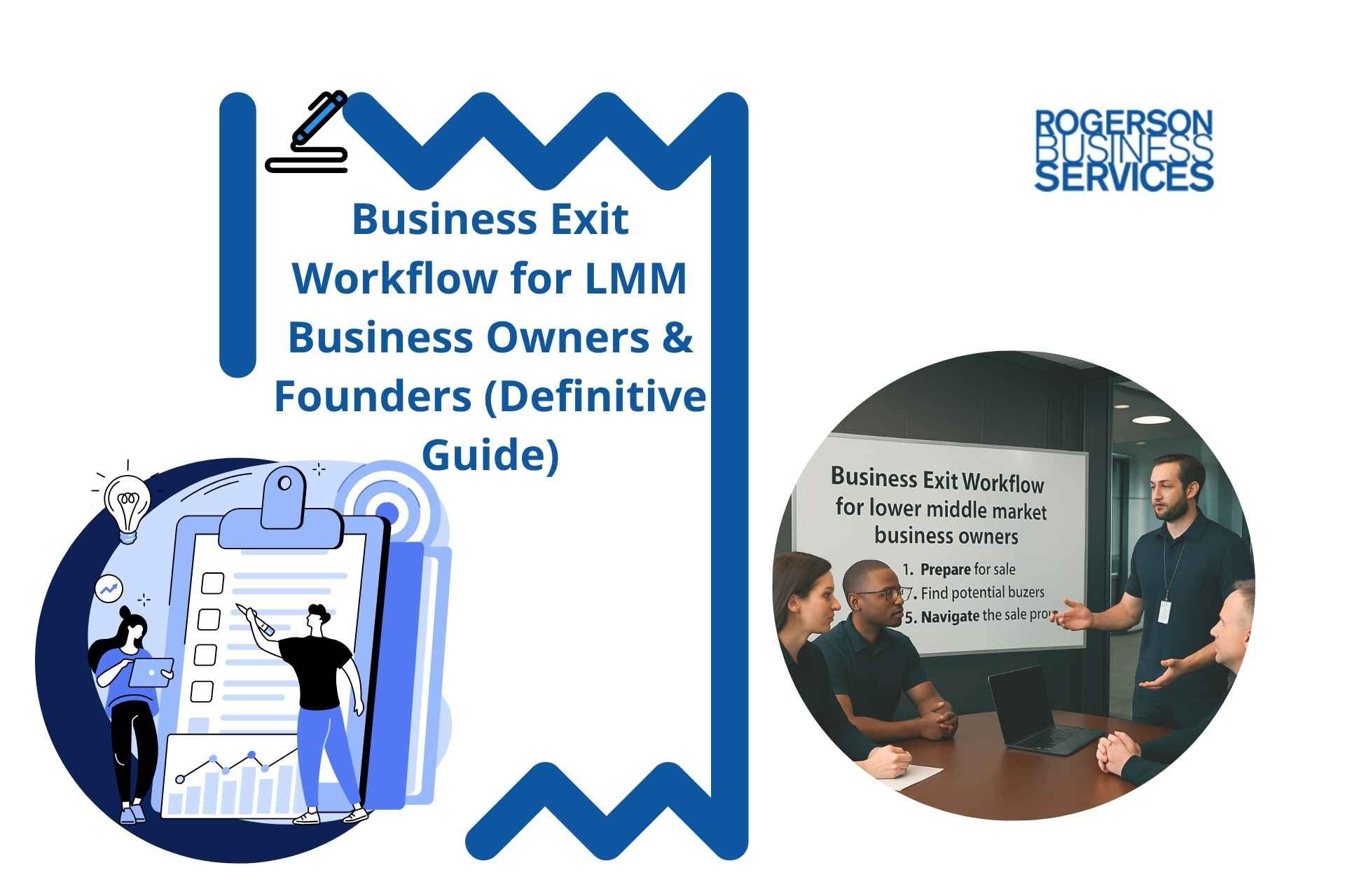
The Definitive Business Exit Workflow for Lower Middle Market Business Owners and Founders
Business Exit Workflow for LMM Business Owners & Founders (Definitive Guide)
By: Rogerson Business Services (California lower middle-market M&A advisory)
About the author/firm: Rogerson Business Services advises owners of $2M–$50M revenue businesses in California on valuation, sell-side M&A execution, and exit planning.
Profiles: CABB · IBBA · M&A Source · Axial · About
Last updated: April 2026
Privacy: If you contact us through this page, we handle your information per our
Privacy Policy.
Selling a founder- or owner-led business in the California lower-middle market is rarely a single “event.” It’s a workflow, with dependencies, deadlines, and points where deals tend to break.
Executive Summary / TL;DR

A typical lower middle market business (LMMB) exit (roughly $2M–$50M in revenue) often takes 6–12 months from “we’re serious” to closing. The timeline isn’t slow because sellers are lazy; it’s slow because buyers will (and should) test the business in layers: financial quality, legal exposure, operational durability, and the transferability of relationships.
Most successful exits are led by a coordinated Deal Team. At minimum, plan for (1) a CPA who can help clean up financial reporting and support tax planning, (2) an M&A attorney to protect you in the LOI and definitive agreements, and (3) an investment banker / M&A advisor to run a disciplined process, build competitive tension, and keep you out of preventable negotiation traps.
At a high level, the M&A lifecycle breaks into four core phases:
- Preparation (Pre-Transaction Optimization) — clean financials, reduce risk, surface value drivers.
- Market Positioning & Outreach — build the story (CIM), identify buyer universe, run outreach.
- LOI & Negotiation — lock key economics and guardrails before diligence.
- Due Diligence → Closing — prove the business, negotiate final docs, manage transition.
If you treat these as separate phases—not one blurred marathon—you can prioritize work that increases deal certainty and improves net proceeds, not just headline price.
Phase I: Pre-Transaction Optimization — The Preparation
Strategist’s Perspective: “Most valuation surprises aren’t caused by the market. They’re caused by preventable ambiguity in the financial story. The earlier you clarify it, the fewer ‘re-trades’ you’ll face later.”
Preparation is where sellers either earn negotiating leverage or give it away. The goal isn’t to make your business look perfect. It’s to make it understandable, defendable, and transferable.
1.1 Financial Clean-up and Normalization
Buyers don’t buy your tax return. They buy a cash-flow story they believe will persist post-close.
That’s why “normalized” earnings matter. In practice, this often means adjusting EBITDA for reasonable, well-documented add-backs, expenses that won’t continue after the sale or expenses run through the business for owner convenience.
Common EBITDA add-backs (examples only; must be supported):
| Add-back category | What it is | Why buyers may accept it | Documentation buyers expect |
|---|---|---|---|
| Owner compensation normalization | Owner salary above (or below) market rate | Adjusts to market comp for a replacement CEO/GM | Comparable salary data, role description, payroll records |
| Personal expenses | Non-business spend run through the company | Not required to operate the business | GL detail, invoices, clear categorization |
| One-time legal/litigation costs | Non-recurring dispute costs | Not expected to repeat | Legal invoices, matter summary, settlement documentation |
| Non-recurring professional fees | One-off consulting or project fees | Not part of ongoing operations | Engagement scope, invoices, timing |
| COVID / disaster anomalies | Temporary disruptions or subsidies | Removes unusual peaks/valleys | Revenue/COGS bridge, explanation memo |
| Owner perks (auto, travel not tied to sales) | Discretionary benefits | Not part of a buyer-run cost structure | Policy notes, receipts, allocation rationale |
The risk most founders underestimate: the Quality of Earnings (QoE) report.
A QoE is a buyer-led (or seller-led) analysis that tests whether EBITDA is real, repeatable, and properly stated. The fastest way to lose credibility is incomplete records, missing invoices, inconsistent revenue recognition, unexplained journal entries, or reconciliations that don’t tie.
⚠️ Warning: If your records are incomplete, the buyer will assume the worst. Even when the issue is innocent, it becomes leverage for delays, escrow demands, or a price cut.
1.2 Identifying the “Value Drivers” (and De-Risking the Business)
Founders often think value is a single number (a multiple). Buyers think in risk-adjusted cash flow. The most reliable way to improve value is to increase durable cash flow and reduce the reasons a buyer discounts it.
Key value drivers buyers look for:
- Recurring revenue: Subscriptions, service contracts, repeatable purchase behavior, and predictable renewal patterns typically feel safer than one-off project work.
- Customer concentration risk: If one customer represents a large portion of revenue, buyers price in the fear of churn post-close.
- Middle management strength: A credible second layer of leadership reduces “owner dependency.” If every key relationship and decision routes through you, the business is harder to transfer.
Practical test: If you left for 30 days with no notice, would revenue, operations, and cash collection remain stable?
Phase II: Market Positioning & Outreach
Strategist’s Perspective: “A buyer can forgive a lot—except confusion. Your job in outreach isn’t to ‘sell’ the business. It’s to remove the reasons a serious buyer hesitates.”
Once the business is defensible, the next goal is to tell the story well and run a process that creates competition without creating chaos.
2.1 The CIM (Confidential Information Memorandum)
The Confidential Information Memorandum (CIM) is the most critical “sales document” in a serious
M&A process. It’s where buyers decide whether your company is:
- a platform they can build on,
- an add-on that complements an existing business,
- or a pass.
A strong CIM typically includes:
- Company overview (what you do, where you play, why customers choose you)
- Product/service mix and pricing model
- Customer profile + concentration disclosure (handled carefully)
- Historical financials + normalized EBITDA bridge
- Operational overview (people, facilities, systems)
- Risks + mitigations (address issues before diligence forces the conversation)
Don’t skip the Growth Story. Buyers—especially private equity-want to know how the next chapter gets written. The Growth Story isn’t hype. It’s a credible, specific set of levers:
- pricing opportunities backed by data
- adjacent customer segments
- geographic expansion
- operational improvements (capacity, lead times, utilization)
- tuck-in acquisition logic if applicable
If you want a clean definition of private equity “platform” vs “add-on” strategies, see Wall Street Prep’s explainer on add-on acquisitions.
2.2 Strategic vs. Financial Buyers
Not all buyers are buying the same thing. Some pay for synergy; others pay for return on invested capital.
| Dimension | Strategic buyers (competitors / synergy) | Financial buyers (private equity) |
|---|---|---|
| Primary motive | Combine businesses to gain scale, customers, or capabilities | Buy-and-build returns + operational improvements |
| What they “pay for” | Synergies, market share, strategic fit | Cash flow durability + growth plan + leadership depth |
| Typical decision drivers | Competitive positioning, integration potential | QoE outcome, leverage capacity, exit pathway |
| Process style | Can be faster, but integration demands are high | Structured diligence; heavy focus on data room |
| Post-close expectation | Integration into a larger org is common | Often keep a platform running; may add acquisitions |
If you’re building your process and documents, Rogerson Business Services also publishes a practical checklist of what buyers will request in Business Sale Documents | Prepare to Sell Your Business.
Phase III: The Letter of Intent (LOI) & Negotiation
Strategist’s Perspective: “The LOI is where you decide the rules of the game. If you ‘save it for the definitive agreement,’ you’re usually saving it for when you have less leverage.”
The Letter of Intent (LOI) is where the deal stops being theoretical. It’s also where many founders accidentally agree to terms that quietly erode net proceeds.
3.1 Understanding Deal Structure
A few structures show up repeatedly in MMB deals:
- Earn-out: A portion of the price is paid only if the business hits future targets (revenue, EBITDA, retention, etc.). Earn-outs can bridge valuation gaps—but they also shift risk back onto the seller.
- Seller note: The seller finances part of the purchase price (a note payable). It can increase total price and broaden buyer pool, but it adds credit risk.
- Rollover equity: The seller “rolls” part of proceeds into equity in the buyer’s new entity. This can create a second payday—but it also means you’re still invested after closing.
Compliance note: Price is not the same as net proceeds. Taxes, working-capital adjustments, transaction fees, and escrow/holdbacks can materially change what you take home.
3.2 The Exclusivity Period (and the Risk of Re-trading)
Most LOIs include exclusivity—a period when you agree not to talk to other buyers while the buyer completes diligence.
Exclusivity can be reasonable, but it changes the power dynamic.
The risk: re-trading, where a buyer lowers price or changes terms after diligence begins, especially when they discover issues or when the seller has stopped running a competitive process.
Practical guardrails to consider (with counsel):
- keep exclusivity as short as the diligence plan allows
- require a diligence workplan and weekly milestones
- define what constitutes a “material” issue that can justify a price change
Phase IV: Due Diligence — The “Valley of Death”
Strategist’s Perspective: “Diligence isn’t a paperwork exercise. It’s the buyer deciding whether your story survives contact with evidence.”
Diligence is where time expands, and emotions get tested. Many LOIs die here, not because the business is bad, but because the seller wasn’t ready to answer predictable questions quickly.
4.1 The Virtual Data Room (VDR)
A Virtual Data Room (VDR) is the organized repository of documents buyers use to diligence the deal.
Most diligence requests fall into five pillars:
- Financial
- Legal
- Operational
- Tax
- IT
Diligence Readiness checklist (starter set):
- 3 years of financial statements (audited or reviewed when available) plus YTD interim statements
- monthly P&L and balance sheet detail with reconciliations
- AR/AP aging reports and revenue recognition policies
- customer and vendor contracts (top accounts)
- employee roster, compensation, and key employment agreements
- IP assignments, trademarks, patents (if applicable) and software licenses
- leases (real estate, equipment), liens, and UCC filings
- tax returns and correspondence (federal + California)
- cyber/IT inventory: systems, access controls, backups, incident history
The best diligence outcomes come from speed + consistency: the faster you can answer questions with clean documentation, the less room there is for “unknown risk” discounts.
Phase V: Closing & Integration
Strategist’s Perspective: “The closing documents aren’t just legal paperwork—they’re the mechanism that decides who pays for surprises after the deal is done.”
5.1 The Purchase Agreement (APA vs. SPA)
The definitive agreement is often called:
- an APA (Asset Purchase Agreement) in an asset deal, or
- an SPA (Stock Purchase Agreement) in an equity deal.
These agreements govern what’s being sold, what’s excluded, and what happens if something is later found to be inaccurate.
A major modern tool in LMMB deals is Representations and Warranties (R&W) Insurance, which can reduce (not eliminate) the seller’s post-close exposure by shifting certain risks to an insurer.
In the right situation, it can also support lower escrow amounts and cleaner exits, though it introduces cost and underwriting requirements.
5.2 Post-Closing Transition
The “soft” side of the deal becomes very real post-close.
Two priorities are common:
- Employee retention: Communicate early (when allowed), protect key leaders, and align incentives. Uncertainty drives departures.
- The 100-Day Plan: Define who owns decisions, what changes immediately vs. later, how reporting will work, and how customer relationships will be managed.
A clean transition preserves value. A chaotic transition creates the conditions for earn-out disputes, customer churn, and culture damage.
Strategic Sidebar: Risk Assessment Matrix
Strategist’s Perspective: “If you can name the top three risks on one page, and show your mitigation plan, you’ll move faster, negotiate cleaner, and close with fewer surprises.”
| Risk category | What it means in practice | Early mitigation |
|---|---|---|
| Regulatory (HSR / CFIUS, if applicable) | Certain transactions may require premerger notification or national security review | Use counsel early; reference FTC’s Premerger Notification Program and FTC current HSR thresholds; for foreign investment considerations see Treasury’s CFIUS overview |
| Tax impact (asset vs. stock sale) | Structure changes after-tax proceeds; allocations can materially alter tax burden | Model scenarios early with a CPA; align structure with goals (liability clean exit vs. tax efficiency) |
| Confidentiality / “rumor mill” | Leaks can trigger employee attrition and customer concern | Tight NDA discipline, staged disclosure plan, and a communications script for leadership |
*Reference FTC’s Premerger Notification Program and FTC current HSR thresholds; for foreign investment considerations, see Treasury’s CFIUS overview
Key Takeaways
- A business exit workflow is a sequence of phases—not one continuous negotiation.
- Preparation (financial normalization + risk reduction) drives deal certainty.
- The CIM is the core sales document; the Growth Story is where value gets defended.
- LOI terms set the leverage dynamics—especially exclusivity and structure.
- Diligence rewards speed, consistency, and evidence.
Next steps
If you want to pressure-test readiness before you go to market, start with a practical checklist: Download our M&A Readiness Scorecard.
If you’d like a private, low-pressure conversation about valuation drivers, timing, and de-risking the process, you can request a confidential valuation consultation (same page as the scorecard).
Bottom-of-funnel option (when you’re ready): Speak with our Lead M&A Strategist.
Disclaimer
This article is for informational purposes only and does not constitute legal, financial, or tax advice. M&A transactions are complex, and outcomes depend on your facts and jurisdiction. Always consult with licensed professionals before proceeding.
Hey there! Can we send you a gift?
We just wanted to say hi and thanks for stopping by our little corner of the web. :) we'd love to offer you a cup of coffee/tea, but, alas, this is the Internet.
However, we think you'll love our email newsletter about building value and properly position your company before transition/exit your business ownership.
As a special welcome gift for subscribing, you'll also get our helping and educational guides, tips, tutorials, etc.. for free.
It's filled with the best practices for retiring serial business owners like Dan Gilbert, Larry Ellison, Warren Buffett, and many more.
Just sign up for our emails below.